Progress on installing the cockpit of my Didi 40cr is going well. The plan is to complete the cockpit while the hull is still upside down so that I can router the edges and glass the seams while working down hand. In Duldey’s 40cr design one side of the cockpit is a 12 mm thick plywood panel which goes all the way from the deck to the hull forming one side of the huge quarter berth in the process. To make it even more robust on one side is a wet locker which stiffens it up vertically and provides support for the front end of the cockpit which hangs in mid air on the other side. Well it does not really hang in mid air but one side of the cockpit is supported from the deck which is not installed yet so I will install a temporary strut in the quarter berth to keep it all steady until the hull is turned and the deck completed.

Didi 40cr cockpit sides being installed in the up side down hull
My Didi 40cr has a wide stern that Dudley has drawn for me and that allows an extra 250mm of cockpit width. It means the quarter berth is 125 mm wider and the locker correspondingly slimmer. It is a much more complicated structure as behind the last frame my cockpit widens out to almost 1.6 metres for a more racing oriented layout. All this discussion is to explain why there is a 45 degree corner on the front of the cockpit and not the standard 90 degree one. Tomorrow I will try to fit the floor in the front half of the cockpit and start the wide section at the back. The first part will be easy as the 12 mm plywood cockpit floor will fit on the 30 mm triangle cleats and just be slid through the 12 mm gap on the frame into the aft section where it will be joined to the 1.6 metre wide section of the floor.

Didi 40cr cockpit sides from the stern showing the cleats on the last frame ready to take the wide floor section
This photo shows the wide aft cockpit section with the sides sloping up to match the angle of the cockpit coamings. It will look very modern.
So tomorrows job is just four bits of plywood, 850 mm wide front cockpit floor, 1.6 metre wide aft cockpit floor and two aft cockpit sides.
Last night the thunderstorms stayed away and we managed a race despite the wet conditions. Racing conditions were truly tricky. Our notable win was a 45 degree lift along the Birchgrove shore that let us clear Long Nose in a single board. Our notable loss was the knock along Snail Bay on the way home where we were trapped between a Black fleet yacht stalled head to wind on the concrete dolphin and a procession of Green fleet starboard tackers coming up with breeze. A couple of tacks here in little breeze and the fleet leaders were gone. It also allowed French Connection to catch us and while we were ahead going into Humbug a big lift for the following yachts did us no good as we had to tack away from the shore on a big header.
Next week it will be fine for the Christmas Party after the race. The forecast says so and I believe it. After all the rain we have had there can be not much left. I want it to be fine for the party and I want the sun to come out so I can get on with the boat building. Today I invested in another tarpaulin to give the hull a double cover and used the time to measure up and cut panels for the cockpit. If the sun comes out I might make some progress.
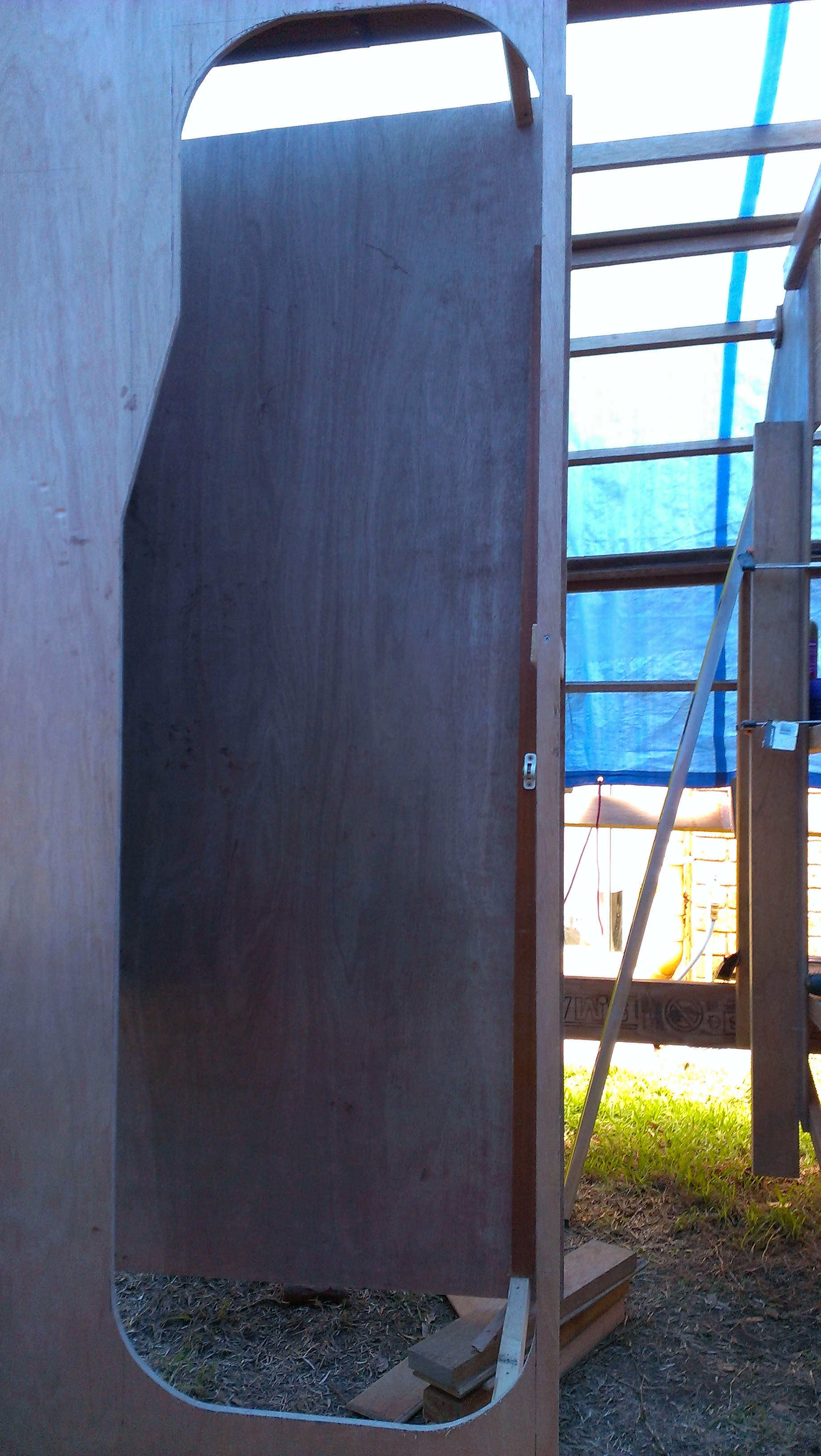
Quarter berth doorway from inside the berth. The taper matches the angle of the companionway steps so we get a bit more with for the upper body.

the finished keel king plank with the hull under covers from Sydney’s thunderstorms
I am forming up the companionway, the quarter berth cabin and the toilet and shower room. As the big flat sheets of plywood are fitted at right angles to the bulkhead this is the time to check the bulkhead alignments and stiffen up any wobbly plywood frames. Because the cleats for the enclosures are already fitted to the bulkheads progress is quite swift and with a bit of luck the two enclosures will be completed tomorrow.
The king plank looks neater with all the clamps removed. The hull is under covers to protect it from Sydney’s thunderstorms. A big one came through Wednesday night causing our twilight race at GFS to be cancelled. Nice BBQ though and the best non sailing of the week.

Kingplank spanning eight floors and extending back into the engine bearer structure
The keel king plank is installed two days ahead of schedule. The plans call for a 15 mm by 150 mm king plank and rather than plane down an 18 mm plank I used the full 18 mm thickness. That saved a bit of time but the real time saver was not having to spline glue the plank in sections. Because the frames behind the keel in the 40Cr version are spaced further apart than in the 38 version the whole length of the king plank could be slid into position in one go.
It is hard to get a good picture but here is a section with the clamp still in place while the glue dries.

The seat sides connect to the keel floors to spread the keel loads
I have started work on the two 300 litre fresh water tanks on my Didi 40cr. This is twice the drinking water storage as we have on Passion and most of the time I carry just 40 litres, filling the tanks only for our cruising jaunts. Even the Beneteau 50 we chartered in the Whitsundays 14 years ago had only 1000 litres storage for six people so our 600 litres will be luxury for two.
The tanks form a for and aft structural member to share the keel loads amongst all the frames and they are the seats in the dinette. The photo shows the access holes in the top of the seats which are needed so that the skin side of the tanks can be coated with epoxy glass. The seat side faces will be glasses before the hull is skinned. The tank top on the left is glued in while the one on the right is sitting in loose in slots I installed to hold the panels for fitting and gluing. You can see the gap between the side and top where it will be glued and nailed later. Almost all the shelves have slots so that the shelves can be slipped into place.

An unwelcome big lift arrived just as we had to tack off the Birchgrove shore
It is getting more difficult to stay at the front of the Blue fleet at Greenwich Flying Squadron. Agrovation, the Jeanneau 379 has a larger No 1 genoa and both Izzi the Northshore 38 and French Connection the Jeanneau 38 are sporting new genoas. The new Dehler 38 is a bigger faster boat and as the crew gain more experience they are picking up fastest times. Worlds Apart will be back soon and we will be lucky to score in the top three.
With more fast yachts in the fleet we are not breaking away and as a result have to contend with slowing tactics from competitors and cannot sail our preferred lines. We did manage a second fastest on Wednesday night despite some unlucky timing of wind shifts which favoured the following yachts. Once the Dehler 28 was clear in the lead we were left to fend off multiple challenges to our second fastest position most notably from French Connection who seemed mighty pleased to be giving us a scare all night.
For a second week we took Out of Africa’s stern on the way through Humbug but this week there was more room to spare and no fright night on board Out of Africa.
We had the big black genoa up and as much power as we needed so there was no time for photos. Hopefully next week we will get back into tourist mode and have some happy snaps to show.
It has taken a while but now that the frames are glassed ready for installation in the hull I am satisfied with the result.

Keel frame top webs with 2mm of epoxy glass covering.
The photo shows the frames with the doubling blocks which compensate for wood lost to the keel bolts already bonded to the laminated beams and covered with 2 mm of epoxy glass laminate. The glass content is 2000 grams per m2 and will add strength as well as protecting the timber. Across the keel the section is 110 mm wide because I have made wider frames and increased the thickness of the doubling blocks to allow for 25mm keel bolts. It is a lot of work and not required for the standard design but then I do like strong yachts.
Readers of my Passion blog will know that I put three extra 80 mm wide by 160 mm deep keel floors and two extra keel bolts in my Jeanneau SO 37 to ensure a long trouble free life.
I should stop referring to the laminated floors as keel frames because they are just the top web of a compound beam made up of the laminated floors, the spacers between the frames and the hull and the plywood cover on the outside of the hull. It is like an I beam with the hull side section a piece of plywood equal in width to the frame spacing. In my case I am adding all that glass to the top web and will be adding glass to the outside of the plywood where it will give the most contribution to structural strength. There will be glass in the bilge to hold everything together and keep out the water but I have not included that in my considerations of the strength of the frames.
Tonight Gosford Laser sailors made up four of six the sailors on board. The welcome addition of two extra seasoned sailors made up for the otherwise occupied regular crew and to show our appreciation we managed a second fastest time.
Genoa selection was vital for a good result. The wind was gusting to 20 knots pre race and was expected to lighten in the evening. With the unfamiliar crew we opted for the roller furling No2 Genoa and were rewarded with a good run to Spectacle Island to lead the fleet at the turn. On the reach to Snapper Island the new Dehler 38 showed that power and waterline length are king in strong reaching conditions and by Snapper she had the inside overlap. To windward working to Goat Island we held the rest of the fleet at bay but had to watch as the Dehler 38 drew further ahead. With the incoming tide there were no fancy tracks to windward.

No fancy tracks tonight
On the reach back from Goat in lighter conditions we had to watch Agrovation with their larger No 1 genoa approach our stern. With a bit of luck a ferry intervened and Agrovation took the route into the lee of Greenwich while we went wider and had more wind. The final tacks into Humbug were difficult as three fleets merged in the narrow water ways in shifty conditions. We tacked away to avoid one round up below and took the starboard tacking Out of Africa’s stern only to have to tack immediately to Starboard to avoid the next line of Starboard tackers. From here we had to pinch to stay above Out of Africa and keep ahead of Agrovation.
Handicap placings were close and we managed a fourth place

Keel frames with the top web half glassed
There has not been much action on the boat building front due to a trip to Perth and three scheduled sailing days since then. It took longer than expected to glue the doubling blocks to the middle of the keel frames and router the edges of the completed units. It also took longer than expected to lay up the first three layers of 495 gram unidirectional glass on the top web of the frame. That is the stage of the photo below. Since then I have added a further two layers to get my target 2 mm of high strength epoxy glass. I estimate the design strength for the unidirectional laminate to be 300 MPa or about six times the strength of the wood onto which it is bonded. Conceptually the 2 mm of very high strength epoxy glass is in tension equivalent to 12 mm of timber which would give a similar strength to a 60 mm frame compared to the 48 mm design. It is not quite the same as the extra depth of 12 mm timber would give different area moments to resist the keel but it is pretty close. Just to be conservative I have assumed a design strength of 150 MPa and I have topped off the five layers of unidirectional with a layer of biaxial under the keelson because once the keelson goes on there is no further opportunity to reinforce the frames. All this glassing is a lot of work and messy work at that but we are installing a deeper keel to improve the windward performance with more righting moment and more lift.

Good tracks for a shifty night
With a full crew back on deck the black genoa was hoisted and the improvement in performance was welcome. Right from the start we were in first or second place and we finished second fastest and second on handicap. To be fair to Passion we were a bit unlucky as we lead around Cockatoo Island by a good margin only to have Agrovation pick up a huge lift from behind. After that we stayed with them all the way to Goat Island only to be forced beyond the lay line by a black fleet J boat. In that delay Agrovation skipped out to half a minute lead.
At this stage the rest of the blue fleet was a few minutes behind but we had the company of the overtaking black fleet to keep us amused. We were pleased with the puff from behind on the way back to Long Nose. This private breeze brought us up to the stern of Agrovation and we made up ground on the black fleet. Agrovation was not about to let us slip through and she carefully covered us all the way to the finish.
Worlds Apart was involved in a pre race incident and did not make the start but the other boat to beat, the new Dehler 38, was behind at the finish so we must have done something right and the tracks indicate as much.

Seven Keel frames fitted to the hull.

6 mm pilot holes have been drilled through the keel and frames
Today I fitted the keel frames to the hull of my Didi 40 Cr to check that they were all true. In the process I drilled pilot holes for the keel bolts to ensure that they are in the middle of the frame. Now that the fitting is complete the frames have to be returned to the workshop to have the doublers added to the front face and to be reinforced with glass. Only then will I be able to fit them permanently in the hull.

Seven keel floors ready for cleaning and dressing.

Fibreglass cheaper by the rolls
The last two days since clamping up the seventh floor frame have been spent buying glass cloth for reinforcing the top of the frames and in cutting out and routering the edges of the 100 mm ply doublers. Buying the glass from Nuplex was the easy task and by buying by the roll I have enough for the hull outside and inside. As well I have purchased the unidirectional glass for the keel floor tops and the first layer on the skin under the keel floor area. The more difficult task was buying a route table and finding a suitable router for it. Eventually I adapted an old Ryobi router to the Ozito router table by drilling the Ozito base plate to suit the Ryobi and that has worked fine. The shopping time has eaten into boat building time so this afternoon I moved into production mode. By nightfall I had routered all the ply doublers and ground all the surplus epoxy off seven frames.
Yes I am quick to write up our victories and slow to comment on our failures and last night was a last place on handicap.
Travel commitments and illness have taken their toll on our crew numbers so we sailed with our old North Genoa which is easy to skirt but short on area and shape. The longer the race went the lighter the breeze and the more we needed the extra power of our big black genoa.
As well as the sail selection we did not get a good run of the wind shifts nor a free passage through the black fleet from behind or the green fleet from ahead. Add to this the fact that the antifouling is getting to the end of its useful life and there is hope that we can get back on our game.
There were some bright spots for the day. Joe Walsh had changed out our genoa halyard pulley for one that turns freely and I managed to install a new shower pump in the bathroom on Passion. Today I picked up a replacement Starboard navigation light cover and by next week all the outstanding jobs on Passion bar the antifouling will be completed.
The post race raft up at GFS was excellent as always and the conditions perfect for a late night motor to the mooring at Woolwich and a quiet row home.

Seven curves tangent to the constant V bottom section which define the keel frames shape
The last keel frame is glued up on the garage floor. It will sit half way between D and E frames and is in line with the chain plates. It is the forward most station that has a radius or 800 mm to the outside of the hull and by gluing it up on a lofted set of blocks the design hull shape should be maintained.
To show the family of curves I highlighted the lines scribed on the floor for the photo.
The longest keel frame was laminated on the garage floor today. This is the aft most frame and has no keel bolts through it but it does share grounding loads. Grounding loads are those extreme forces generated when you are flying along at eight knots and hit an immovable reef. The rear frame structure has to be strong enough to stop the back of the keel breaking the backbone. There are three frames sharing these grounding loads and they are all tied together fore and aft with a keelson structure and with the sides of the engine bearers. As a bonus there is a big frame that forms the front of the galley and engine housing and that is right above the aft end of the keel. By my calculations if we hit a reef all that will happen is the bow will dive down while the stern rises up and the water will act as a shock absorber. There are two more frame so do but these are the two shortest ones at the front of the keel so just two more days work to finish all seven frames.

The longest keel frame that will support the engine bearers.