
First plywood panels fitted to my Didi 40 cr and showing keel bolt template
Final fairing of the keel before fastening the plywood took longer than expected so I managed only two ply panels on the bottom today. As well as the final fairing I set up the keel bolt templates on the inside and outside of the keel, checked that they were positioned correctly and opened up the pilot holes. This task was on my job list to be completed before the plywood is secured over the keel area. It is taking longer to trim the keel than I expected so I think it will take another three days to complete the bottom panels.
The new build is now covered with 12 mm plywood from stem to stern and from gunwhale to the radius chine. I have been very pleased with the progress and on Tuesday last I fitted four sheets in a long working day that finished in moonlight.
Moonlighting on my Didi 40 cr
Today the fairing of half of the bottom was completed ready for the first ply sheets. Dudley says not to fair the keel to far ahead of fitting the plywood if you are working outside so I am sticking to his recommendations. A really sharp had saw is ideal for establishing the level across the keel and stringers

The keel and full width keel frame blocking have been faired ready for the bottom sheets.
I am also doing the two sides together. Once the first side is cut and trimmed to the radius chine line I use it as a template for the second side and so far that has worked well.
Some of the off cuts from the side panels will be large enough for the smaller bottom panels so there will be fewer full sheets to carry back and forth from the hull to the workshop.

Off cuts from the side panels will be ideal for the narrower bottom panels
As a bonus item Dudley has a new post on his blog with a really good photo of the prototype Black Cat.

Photo of the interior of Black Cat the prototype of the Didi 40 Cr that I am building
You can read the article here
http://dudleydix.blogspot.com.au/2015/02/what-saints-did-next.html
The original article with more photos can be read here
http://whatthesaintsdidnext.com/2015/01/30/black-cat-champion-race-yacht/comment-page-1/#comment-81
You will need to scroll up from the comments to the top of the article to see the photos.
Wednesday was a good day to pick up Passion from Noakes and return her to her mooring at Woolwich. I arrived at 7 am and Passion was in the travel lift ready to be launched. In quick time she was back on the mooring and I did a bit of housekeeping while waiting for Elaine to taxi me back to Noakes to retrieve the car. En route we had coffee in Blues Point Road and a chat with one of our sailing friends before heading home.
The forecast for the evening race was for around 20 knots so the No 2 genoa which was already on the furler was the logical choice. The smaller genoa worked well while the breeze was fresh and we were comfortably second behind Saoirse, the Dehler 38 with the unpronounceable Gaelic name. In the lee of Cockatoo Island on the tight reach to Goat we were run over by Izzi and French Connection who found some breeze in the lee of the island. Izzi soon dropped on us and gave us all the dirty air they could find while we pinched up to pull clear ahead of French Connection. At the clearance mark at Goat Island we were dead ahead of French Connection with a lead of 20 metres when a big lift put her alongside and we were forced to tack behind her stern. She promptly tacked on us and started to bear down to give us her dirty air. We were pinching as high as we could to clear the island so we could not force her higher but neither could we tack away from the shore. I don’t know how we cleared the last pylon but we managed without being knocked onto port into French Connection so we lived to fight another day. Now we were chasing three yachts. Izzi had made up a lot of ground on Saoirse but could not bridge the last gap. Fench Connection was just ahead and we had every intention of blanketing her once around Onion Point but alas the wind would not cooperate. We found our own private wind eddy and stalled while they took off and lead us over the line by a minute and a half.
As disappointed as I was with the result I felt for Gwhizz who got separated from the leaders and never made it back to the top group. Avanti who had been sailing well the past few weeks was also well behind so mid fleet was not a bad result for Passion given the fading conditions.
Remarkable the rain stayed away for the Wednesday twilight race and for the post race post mortems and barbecue. As we came dead last I performed an autopsy on Passion and can report that the death in the race was due not only to getting becalmed on the corner of Goat Island but also due to a healthy weed garden growing under the wing keel. I have never seen so much weed and barnacles on Passion but I do admit that it is 18 months since the last antifouling.
Thursday was a brilliant morning to be woken up by the waves from the 6am ferry. After a breakfast of rice bubbles and a cup of earl grey it was time to take Passion to Noakes for the scheduled post mortem examination. The lift was waiting early so I motored straight into the slings and was off in a few moment ready for the inspection.
I predict Passion will be back with a vengeance for the Autumn series.
Back home the skies were clear so I removed the tarps from Next Passion and started the ply cladding. The 2.4 by 1.2 metre sheets of ply are not the easiest to handle so Elaine assisted with the transfer from the garage to the building site and before long I had a sheet cut to size, the edge routered for the join to the curved section and all the fastening holes pre drilled. By marking all the stringer locations on the back side of the ply sheet I get a guide for applying the glue and a guide for drilling the fasteners. There are about 40 fasteners per sheet so a methodical approach is well worth the effort.
The final fairing of the stringers took longer than expected but on the other hand the tolerances are very fine and the glue joins quite thin.
It is probably just as well that I ran out of screws as fitting the second sheet would have added a couple of hours to what had already been a busy day.
Today I procured enough fasteners for fixing another five sheets, fitted the second sheet to the bow opposite the first and fixed a second sheet to the starboard side. The second sheet for the port side was cut using the starboard one as a template and it is ready to go when I am.
The second sheet ties in with the chainplate support and the two shelves on either side so there is quite a bit of fairing to be done to ensure nothing distorts the ply sheets. There will be less as I move to the stern and there might be a chance to improve on the two sheet a day production schedule. There are 20 sheets to go before I move to the moulded ply radius chine section.
The photo you are waiting for is here

The first two sheets of plywood installed on the starboard side.
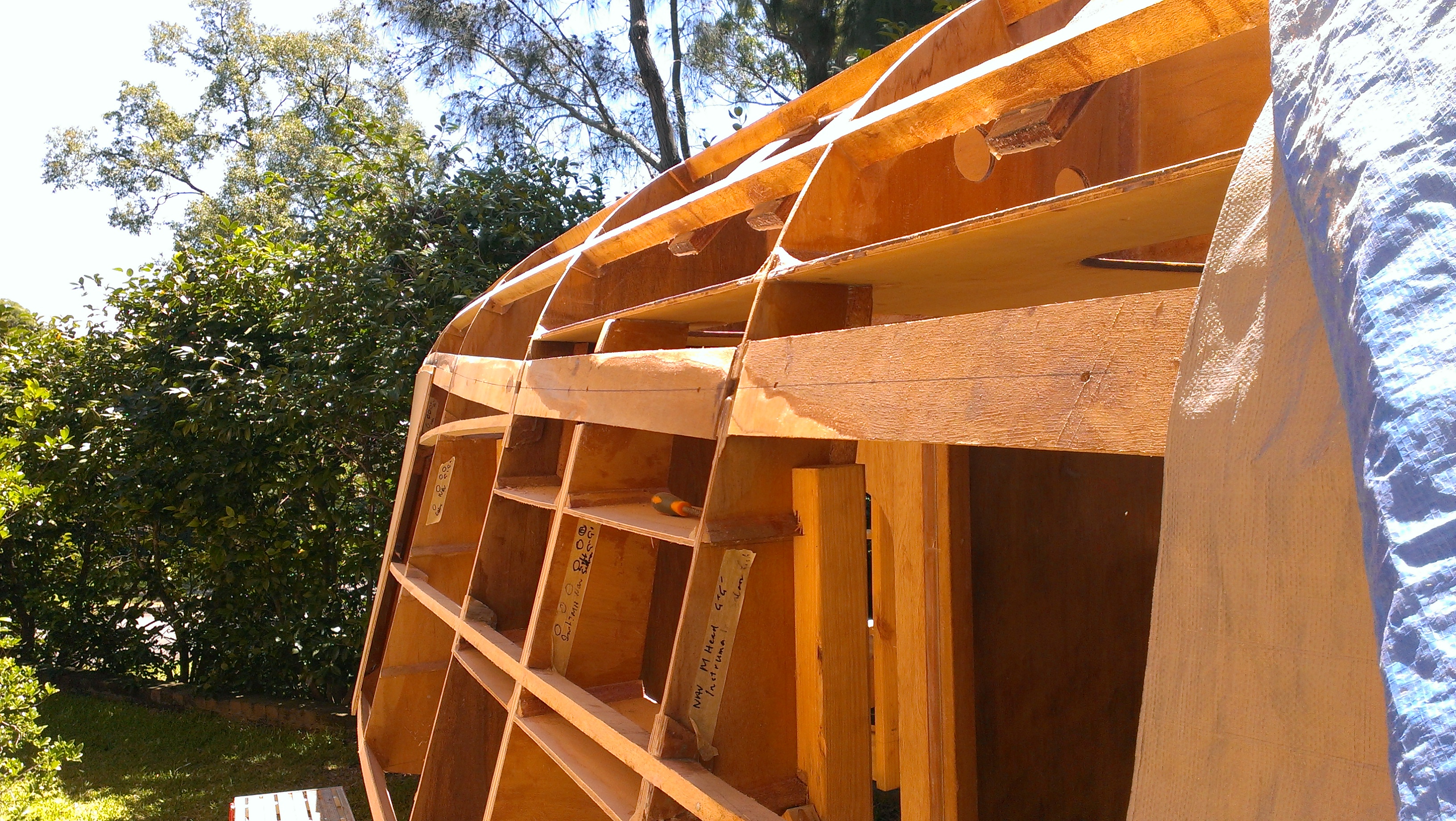
The join in the ply has to line up with the centre line of the stringers so that has to be marked on the face of the ply doublers.
Monday was the coldest Australia Day in Sydney for 50 years and the cold and wet has continued thwarting my plans to start skinning the hull. In the forced lull I have fitted four of the six locker shelves in the quarter berth. If the wet persists I will adjust the frame support and complete the last two shelves and perhaps the locker fronts as well.
Plan B for an extended wet period is to complete the shelves in the saloon. I have already completed the shelves either side of the chainplate supports so there are four more shelves that could be installed and I and can complete the locker fronts if I get desperate for jobs.
The tarpaulins are doing a great job of keeping the hull dry and the underside of the cockpit is proving to be a great workbench. It is reinforced with 450 grams per m^2 of biaxial glass in West epoxy so the plywood is well protected.

Fitting quarter berth shelves is an ideal wet weather task.

The underside of the cockpit has proved to be a great workbench.
I spent the day fairing the stringers and ply doublers that run into the stem and keel. The tools were the Makita power plane, a long hand plane, two templates for the radius sections at the forward stations and a long coarse torture board. Late in the day the grandchildren came to visit and checked the accuracy of my fairing with my straight edge. I was able to demonstrated how the the torture board is useful for final fairing.
The photo shows how the pointy end looks after the fairing.

The pointy end of my Didi 40 Cr after fairing and torture boarding.
While I was dusty from the power planing and hand fairing I used the sanding disc on the angle grinder to trim back some of the keel blocking pieces so I am almost ready to glass in the keel frames to the water tanks sided.
After dark I used the laser level to check the centre line from the stern through the two centre line keel bolt pilot holes and on to the newly faired stem. As all was in perfect order I am ready to start the plywood cladding. The only thing holding me up is a few jobs that will be easier to do before the cladding is installed such as sealing off the keel frame to water tank joins.
While the covers were off for the laser check of the centre line I took a few photos for the record showing the ply doublers added to the required stringers and the keel blocking in place.

Didi 40 cr with ply doublers and keel fram blocking ready for the ply cladding
Another photo looking forward shows some of the internal structures already in place.

Didi 40 Cr with internal structures in place prior to skinning the hull.
We tried to hide from the big 2 metre tide that was a maximum run in by going for the Birchgrove shore only to be thwarted by a big lift out in the middle that carried four of the fleet past us from 200 metres behind.
Our evening started well with the selection of the repaired No 2 genoa, a good start and a better line out wide from Greenwich. Down low on the broad reach to Cockatoo Island we had a better angle to lead at the turn. Down the Cockatoo shore the square run meant we were blanketed from behind but we managed to find enough clear air to round Cockatoo ahead. By now the breeze had build to 20 knots and our No 2 and plenty of backstay was proving a good selection for the beat to windward. So well were we travelling that we cleared Cockatoo with a good lead and chose to take the knock into Birchgrove to get out of the tide. Unfortunately the tacking angles meant we were going back and forward across the tide which produced some horrible tracks on the chart plotter.

Whoa! Big tide and unfavorable wind shift phasing made for awful tracks.
The fleet behind received a big lift which allowed them to do a straight line to Long Nose while we travelled twice the distance to get back to their line.
Worlds Apart had steamed through, Izzi out even wider was outperforming her handicap and Avanti with a clean bottom was back to her best performance.
Around Goat the super quick Dehler 38 and Gwhizz were benefiting from a good quirt of following wind. We went wide to avoid the wind shadow around Goat while the Dehler 38 and Gwhizz found enough wind to power through the wind shadow above us.
Now I was feeling a bit depressed as we had gone from an early lead back to sixth place using quite reasonable tactical decisions. The run back to Cockatoo was no fun as the fleet with their larger head sails were enjoying the lighter and more free conditions. Our only hope was for a return of wind on the beat back through Humbug. We got our wish and started to catch up along the Hunters Hill shore. At the first sign of softness in the breeze we eased the back stay and powered up the head sail and with a lucky lift along the Onion Point shore managed to make up a couple of places and a fair chunk of time on the fleet.
Before I start fixing the plywood skin to the hull I am completing all the blocking that goes from under the keel frames to the plywood inside face. Each layer of blocking can be fitted and pressed into place in a bed of epoxy resin like a tile in a mosaic. Once all the blocks are in place the surface will be planed so that the plywood can be glued direct to the underside of the frame. The central layer of the blocking has only to resist the shear stress in bending and as it is on the neutral axis this is where 30 mm square access holes are located to carry all the water services and bilge pump plumbing. The bottom most layer of blocking is against the hull and is continuous except for the limber holes needed against the keel and stringers. Against the keel directly above the limber holes the frame section is 110 mm wide, 80 mm deep and encased in 2 mm thick high strength epoxy glass so it is a very impressive structure. Two stingers run through the blocking area on each side so there are between 8 and 12 blocks per layer for each of the seven frames. It is quiet time consuming to shape the blocks to transition smoothly from the 80 mm wide sections to the 110 mm wide section between the keel and king plank but a good smooth transition is needed so that the glass cladding is well bedded down for maximum strength. I have calculated that in the keel frames and blocking there is 224 individual pieces varying from metre long 80 mm wide by 6 mm deep layers in the frames to tiny pieces with two 45 degree angles. As a result of this time consuming task progress looks slow but it will pay dividend minimising the time for completion after the hull is turned. If I have counted correctly I have just 28 little pieces to cut and fit before I can start fairing the section in preparation for the skin.

Near side frame with 30 mm access holes through the neutral axis and far side frame with the extra layer of blocking spanning the access holes
During the hot days last week I left a few projects for the wet days so a little work was done under the new tarpaulin. The cleats for the quarter berth plywood bunk bases are all but completed and if the wet weather continues I might also install some shelves in this area. The wet time has also been used to plan the location of all the electrical circuits, light fittings and water services. There are little bits of masking tape all over the bulkheads with little hieroglyphics which meant something when I scrawled them. With more rain forecast this week I am going shopping for some serious bits like the rudder stock and prop shaft so that I can get these aligned while I can still get a laser line through the hull.

Another tarpaulin to keep the hull dry
The photo with the new tarpaulin stretched over the hull gives a good idea of what the finished product will look like. The piece of plywood sitting under the tarp at the stern does spoil the smooth lines but it is needed to bridge the gap between the transom and the aft perpendicular because there is no keel in this area and without the ply the tarp sags and fills with rain water.
With the Laser still making the way back from Mandurah we took the opportunity to enter Passion in her first Greenwich Flying Squadron down harbour race. Ron celebrating his birthday came all the way from Manly to sail all the way back again and possibly would have jumped ship and swam ashore if he had know what a slow ride we would have back home. In a fresh breeze we swept out of Humbug ahead of larger and faster yachts and held a good position relative to our peers while the breeze was fresh. The outgoing tide was sweeping us along at a good rate and making the tacking angles on the chart plotter look spectacular.

Passion tacking angles with an outgoing tide
Mid harbour as the breeze lightened we took an unfavourable knock which allowed Gwhiz to catch us. In the dying breeze we never looked like catching her again although we did get up to her transom on the turn at Manly East. Now we had turned against the tide and with the wind dropping to 6 knots we made very slow progress. Around Fort Denison we changed course to avoid a large P&O liner exiting with excited passengers while we wallowed along. A check of the race time limit gave us no reprieve as the limit was 5 hours so we hung on to the slow end to finish our first Down Harbour Race. A special thanks to Ron for crewing on his birthday.
For our first twilight race of 2015 the winds were well in excess of forecast with one competitor sighting a reading of 30 knots. Sensible sailors withdrew in the gusty conditions while we battled on against round up after round up as the bullets hit the fleet.
We had set the North No 1 on the furler for the evening. This is quite flat and has been cut down with a good leech hollow so it suits wind conditions from 15 to 20 knots. For the first running legs of the race we set the full main and lead the fleet around the islands. On the work back up along the Hunters Hill shore we put in a reef losing only 20 metres in the process. That allowed the Dehler 38 to slip by to leeward but on the next favourable wind shift we snuck back into the lead which we held until the headsail tack snap shackle broke. We had two spare snap shackles attached at the bow off the furler so it took just a few moments to ease the genoa halyard and reattach the tack. That was long enough for the Dehler to sweep by and that was the last contact we had with this speedster.
Worlds Apart was now on our transom and we held them to Goat Island but had to tack to clear the mark while they had the extra 5 metres needed to round inside us. The time lost in the two tacks also allowed Izzi to overtake us in the lee of Goat so we had three boats to follow home.
In desparation we took out the reef to hold out a fast finishing French Connection but as we did so the wind reappeared with a vengance making the work up Humbug all the more dangerous. Fortunately for us the crew on French Connection noticed our predicament and pulled away for safety which allowed us to carry on to the lay line to the finish. They were not rewarded for their kindness as the green division yacht to windward of them was slow to respond on Onion Point leaving French Connection stalled within metres of the shore. Post race they assured me they did not hit bottom but it must have been close.
For our efforts Izzi was first, Passion second and French Connection third so they did not go home empty handed.
Externally it seems no progress has been made on my Didi 40cr but behind the scenes little steps have been made. The underside of the cockpit floor is all but completed. Where the top of the rudder post is mounted all the reinforcement is in place, nicely routered with 6mm radius corners and double coated with epoxy resin. The corners that are not secured with cleats are double taped with epoxy fibreglass, sanded back and top coated with clear epoxy so that section of the yacht is finished.

Completed rudder post top support structure
Under the forward part of the cockpit where it is 850 mm wide the glass reinforcement has been sanded and primed with a first coat of Interguard. This is a good place to practice getting a good finish on the glass covered plywood. Despite the use of peel ply over the glass the finish is not as flat as I expected so I need practice spreading the epoxy with a fine nap roller to minimise the amount of filler required for the production boat standard I am trying to achieve.

First coat of Intergard primer on the cockpit underside
Elsewhere the inside of the water tanks have been lined with a light woven glass cloth had double coated with epoxy resin. Once the skin is on the hull that surface of the water tank will be lined from the access hatches in the top. It will be tight work but at least it will be downhand.
One of the next steps is to cut all the access ways for the electrical cables, water pipes and engine services. I want to do this while I have good access to the bulkheads and before the skin is started.
With the Laser on the way to Perth Saturday was free for Elaine and I to enter Passion in the Greenwich Flying Squadron Saturday race.
It was a picture perfect day for a race with the only downside a burnt face from the sun reflected back from the water. Despite wearing a wide brimmed hat all day I have suffered from not putting on the sun screen. On the course we did not expect to be competitive as we were not going to set spinnakers so we set ourselves the modest expectations of having a good time. After a few tacks we got into a routine of Elaine loading up the new sheet on the winch and letting the old one off as we tacked. Unfortunately the genoa clew kept catching on the stanchions and life lines which meant Elaine had to take the helm while I dashed forward so we tacked as little as possible.
Between us we got quite a work out. Elaine wore her knees out on the non skid so a set of knee pads will be in order for the next occasion we do a two hander. We achieved our objective of having a good time and were quite happy that we kept in touch with the fleet.

Tracks for Saturday’s race at GFS
Just as I wished last week the rain held off for the Christmas party at Greenwich Flying Squadron. With all the sad news from the past few days it was hard to get into the festive spirit. At times like this I recite the lines from one of Milton’s poems about the bird that visited his window. “Then to come in spite of sorrow and at my window bid good morrow” The sailing was not up to the result we expect due mostly to the state of the antifouling.
This has been the longest Passion has gone without new antifouling so I will book her in in the New Year and see if we cannot get back to the front of the fleet. The new stiffer batten in the top of the main does free the leech of the sail but it is getting caught on the back stay especially in the lighter conditions. At least twice we had to drop the main halyard to get the sucker to go through the back stay so I guess the running back stays on Next Passion will be no more trouble.Our tracks on the course looks spectacular with the help of the run out tide. Everyone else’s tracks must have looked outrageously good judging by the time we finished behind.

Crew and friends at the BBQ
The bright spot for the evening was definitely the raft up and BBQ with live entertainment and some traditional carols to get us into the Christmas mood. We packed in over 250 people and the social committee and twilight crew did a marvelous job. The raffle raised $1800 of which $900 was donated to the Salvation Army and that amount has already reached them.
Today I pottered around on Next Passion fitting the chain plate supports and preparing the cockpit underside for reinforcing fibreglass. Elaine washed the Santa Hats from last night and they looked cute hanging on the line so here is the photo for the week.

Santa hats washed and drying for next year with Next Passion under tarps in the distance
Sad day in Sydney with the hostage drama and the loss of two great lives. It is hard to be cheerful when there is so much sorrow but I battled on with the four sheets of plywood that would finish off the cockpit. First I had to cut dress fit and install some floor bearers for the 1.6 metre wide aft section. While the glue was curing I cut the four panels and fitted and installed them progressively. It was a big glue day with some long and wide gluing surfaces which required a big batch of glue. In the heat it was a battle to spread the glue before the mass in the glue pot heated up and accelerated the set time. To keep the glue time short each panel was pre drilled and temporary supports places so that the panel could be placed promptly. The process worked well but it was a long day and well after six when I downed tools happy with the effort.

Didi 40cr wide stern racing cockpit fitted and glued in place
The photo shows the 850 mm wide fore cockpit and the 1.6 metre wide aft cockpit which gives a lot of room for a racing crew. Next job is to router the edges of the underside of the cockpit and glass the underside. I am going to glass both sided of the cockpit floor for in the front section to avoid the need for deck beams that would protrude into the quarter berth space. Instead the underside or the cockpit floor will be smooth. The join in the two sections is a butt join staggered so that the join is not in line with the frame. Once the hull is right way up the join will be ground back and glassed for a strong durable join.