We are five weeks into the Winter Wednesday Series run out of RANSA and it has been an interesting start. The first race was run as a non point score due to an extensive change in courses. This gave the organisers an opportunity to move boats between the fleets. In our Division 1 we lost the Sydney 38s, Agrovation and Love Byte and gained the big Marloo. The Div Zero course was shortened so that the smaller yachts in that division could finish in a respectable time.
We liked the course change as the Div Zero yachts were rounding Lady Bay at the same time as the lead boats in Div 1 and that gave us good opportunity to check our performance against them. Unfortunately, the combined fleet mark rounding was not to everyone’s liking and their course will change from next week.
In the heavy air races we have scored two fastest times and one second fastest while in the non point score light air race we could manage only a sixth fastest place. We are still learning how to sail the yacht in the heavy airs and this week was the first race with a reef in the carbon main. I feel we can improve our windward performance in 20 knot conditions if we can sail a slightly lower angle and to achieve this we will try sheeting the jib further back on the tracks and a little more wide at the spreaders.
To address the light air competitiveness, we need an overlapping genoa. The No 1 jib needs 8 knots for the top batten to follow the shape. After trying lighter and lighter battens we reduced it to just a leech batten. Yhe short batten did now work and we are reinstalling the softest full length one. Luckily we have a very understanding sailmaker. So I think we have gone as far as we can with the jib. The large code Zero from Passion X proved too large for normal fleet racing. it would have been a huge hit to the ORC rating and been useful only on long tight reaches so it will be retired to the garden shed. In its place we will try a conventional 140% overlapping genoa set between our gunwale wide V1s and our cabin side D1s. It will be designed to just clear the lower spreaders and should achieve an area of close to 50m2. That will be a big jump up from the 42 m2 No1 jib and should make a difference. I tested an overlapping genoa from Passion X and it seemed to work well despite being only 40 m2. The genoa will be without battens so there should be no issues in light airs.
The VPP available on the ORC website show a small speed increase up to 10 knots of breeze and no loss of performance above that. In my heart I feel the low air performance will be much better than the VPP predicts particularly in low wind close reaching. A bonus it the hit to the ORC rating is tiny going from 1.2357 to 1.2443.
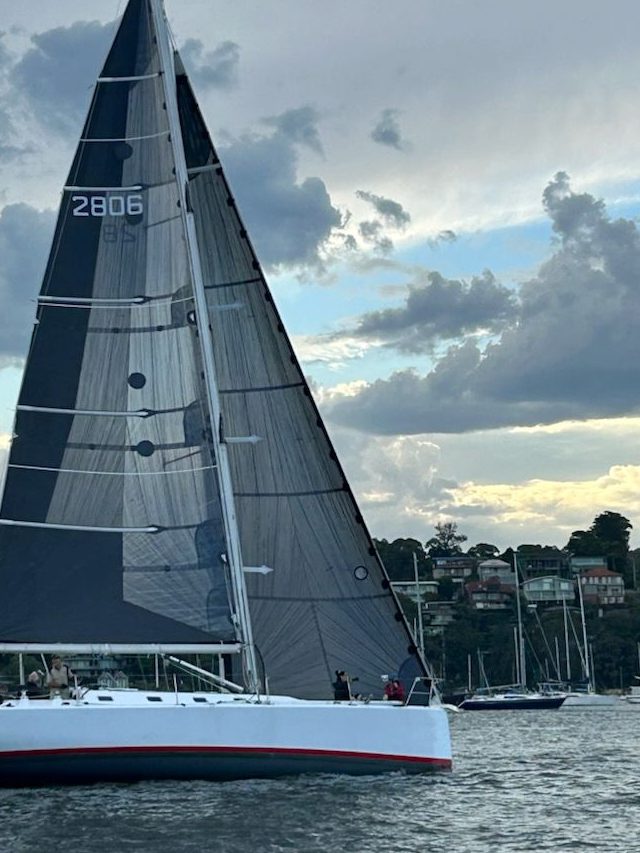
Following the exciting fastest times in the windy conditions we had less success in the next medium air race. The overriding issue was that we went right to stay out of the tide while the shift came from the left and was a progressive shift that through the one long windward leg clocked around 25 degrees. This was a classic caught on the wrong side as we never got a lift back. Britannia was over the same side and apart from a very short burst out of Watsons Bay they were also badly affected by being on the wrong side. The long square run to Shark Island was not helpful as the fleet seems to sail at similar speeds. Once on the reaching legs from Shark Island to the Naval buoy No 3 we started to make up ground and by the end of the race has made up a couple of minutes but the early damage was irrepairable.
It does not seem time to panic unless you look at the current forecast for next Wednesday which looks very much like a light weather specialist race and a handicap improver for Passion XI. It is going to be character building.
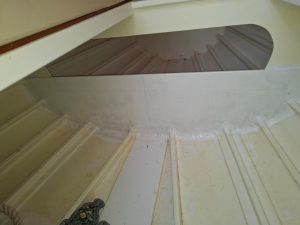
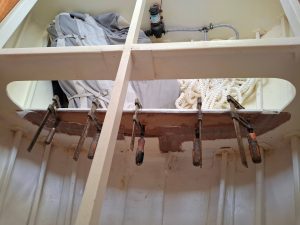
Now is confession time as prior to going to Port Stephens we found fractures in the bulkhead under the V berth. These were attributed to very heavy slamming conditions going out or Pittwater when we were motoring directly into the short sharp chop. In consultation with the designer we identified the problem and instituted an immediate repair before heading off the Port Stephens. The thickness of the bulkhead plywood was insufficien for the size of the cutout in it so the plans were quickly upgraded. For our frame with a large cutout we reinforced the 9mm ply with a 12 mm ply panel which was 370 mm tall rather than the 200 mm of the original. The repair worked perfectly and while we experienced similar slamming conditions coming out of Port Stephens on the way back home the reinforced bulkhead survived well. Subsequently I have augmented the original 9mm ply by 200 mm high with a panel that creates a full 21mm thick ply panel 370 mm high with the join between the originl 9mm ply and the new 9mm ply addition glassed over with two layers of 425 gm double bias glass. It is all smoothed and painted with two coats of two pack epoxy and looks like it was always meant to be thus.