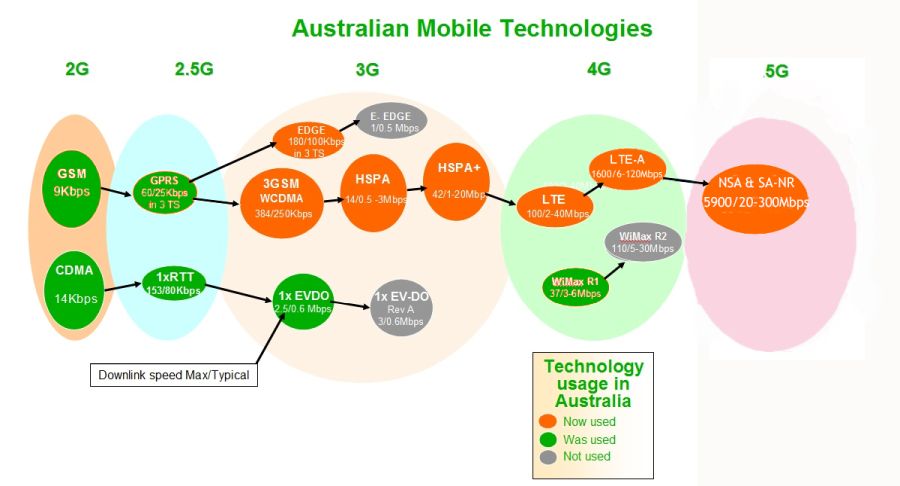
Mobile Generations
1G (First Generation) 1979 → early 1990s
There were more than a dozen different 1G mobile systems with many European countries having the own version along with Japan, USA/North America.
The most common was USA’s AMPS which was used in North America and derivatives deployed including in UK, Italy and Australia. All were entirely analog.
The radio access network (RAN) used frequency-division multiple access (FDMA) with no encryption, making calls easy to intercept and prone to interference.
The core network was circuit-switched and relatively simple, designed only for voice routing. Features were limited to basic voice calls, with poor quality and no data capability. Use cases were primarily mobile telephony for business and emergency communication, marking the first real step away from fixed-line phones.
2G (Second Generation) 1991 → 2010s (some still active)
2G introduced digital communication, with the number of standards reducing dramatically and dominated by the European originated GSM and USA originated CDMA.
The RAN used TDMA or CDMA techniques, significantly improving spectral efficiency and call quality while enabling encryption.
The core network remained largely circuit-switched but began integrating packet-switched data elements (e.g., GPRS). New features included SMS, MMS, and limited data services. This generation enabled mass adoption of mobile phones and basic text-based communication.
3G (Third Generation) 2001 → early 2020s (now being retired)
3G systems like UMTS and CDMA2000 brought switched data to the forefront.
The packet RAN used wideband CDMA technologies, allowing higher data rates and simultaneous voice and data.
The core network evolved into a hybrid of circuit- and packet-switched domains. Features expanded to mobile internet, video calls, and multimedia messaging.
This generation enabled early smartphones and applications like email, web browsing, and basic streaming.
4G (Fourth Generation) 2009 → present
4G, led by LTE, marked a full transition to all-IP networks.
The RAN uses OFDMA (downlink) and SC-FDMA (uplink), delivering high data rates and low latency.
The core network (Evolved Packet Core, EPC) is entirely packet-switched, eliminating circuit switching altogether.
Features include high-definition video streaming, VoIP (VoLTE), and advanced mobile apps. 4G enabled communications necessary for the modern smartphone ecosystem, including social media, cloud services, and a multiplicity mobile apps.
5G (Fifth Generation) 2019 → present (growing)
5G, based on 5G NR, introduced flexible, software-defined networking.
The RAN uses a wide range of spectrum (sub-6 GHz and the so far not widely deployed mmWave) with massive MIMO and beamforming for high capacity and ultra-low latency. 5G was introduced into two main stages 5G NSA Non Stand Alone introduced 5G NR RAN but controlled by 4G core network and protocols. It offered new spectrum and RAN capacity.
Full 5G capability came with 5G SA (Stand Alone) with the introduction of new 5G core and protocols.
The core network (5G Core) is cloud-native and service-based, supporting network slicing. Features include ultra-reliable low-latency communication (URLLC), enhanced mobile broadband (eMBB), and massive IoT (mMTC). Use cases expand to autonomous vehicles, smart cities, AR/VR, and industrial automation.
6G (Sixth Generation – Emerging post 2030
6G is still in research, driven by 3GPP with strong input from academia, industry operators and suppliers.
It is expected to support all current mobile frequency bands but to add far higher frequencies with massive capacity once the considerable practical challenges of propagation in these bans is resolved. AI-native RAN, and highly network integrated sensing and communication are expected to be supported.
The core network will likely be fully cloud-native, AI-driven, and deeply integrated with edge computing.
Compared to 5G, 6G aims for even lower latency, higher reliability, and tighter integration between digital and physical environments. Anticipated features include holographic communication, digital twins, and pervasive intelligence, with uses spanning advanced robotics, immersive experiences, and global connectivity.
Australia Mobile Generation Timing
1G in Australia (1980s → early 2000s)
Australia’s 1G system was the analog AMPS network, launched by Telstra (then Telecom Australia) in 1987. It provided basic voice services with limited coverage and poor security. Remarkably, Australia kept 1G running longer than many countries, with Telstra finally shutting it down in 2000. Optus also operated an AMPS network before transitioning to digital.
2G in Australia (1993 → ~2018–2024)
2G began with GSM:
- Telstra: Launched GSM in 1993, alongside a CDMA network later. Shut down GSM in 2016.
- Optus: Launched GSM in 1993, shut down in 2017.
- Vodafone Australia: Launched GSM in 1993, but held onto it the longest, finally shutting down 2G in 2018.
2G enabled SMS and basic data (GPRS/EDGE). After shutdown, spectrum was refarmed for 4G/5G.
3G in Australia (2003 → 2024–2025 shutdown)
3G arrived with UMTS:
- Telstra: Launched its “Next G” (850 MHz) network in 2006, replacing CDMA; shut down June 2024.
- Optus: Launched 3G in 2003, shut down September 2024.
- Vodafone Australia: Launched 3G in 2005, shut down December 2024.
3G powered early smartphones, mobile internet, and video calls. Its shutdown in Australia was relatively synchronized across operators.
4G in Australia (2009 → present)
4G LTE (LTE) rollout:
- Telstra: First to launch in 2011, rapidly built the largest coverage footprint.
- Optus: Launched in 2012.
- Vodafone Australia: Launched in 2013.
4G remains the backbone network in Australia today, supporting VoLTE, high-speed data, and nationwide coverage, especially in regional areas.
5G in Australia (2019 → present)
5G using 5G NR:
- Telstra: First launch in 2019, leading in coverage and mmWave trials and limited deployment.
- Optus: Also launched 2019, focused on both mobile and fixed wireless.
- Vodafone Australia: Rolled out from 2020 onward.
5G is expanding across major cities and regional hubs, enabling faster speeds, lower latency, and fixed wireless broadband alternatives.
Australia Generation and Technology Summary
| Generation | Telstra | Optus | Vodafone |
| 1G | 1987 → 2000 | 1980s → 2000 | — |
| 2G | 1993 → 2016 | 1993 → 2017 | 1993 → 2018 |
| 3G | 2006 → 2024 | 2003 → 2024 | 2005 → 2024 |
| 4G | 2011 → present | 2012 → present | 2013 → present |
| 5G | 2019 → present | 2019 → present | 2020 → present |
| Technology | Standard | Speed | Speed Up | Added Features | Spectrum MHz | Company | Launched | Notes | |
| Down | Up | ||||||||
| PAMTS 007 | 0G | Pre-Cellular | NA | NA | Mobile Voice | 500 | Telecom | Aug-81 | No handover or frequency re-use – Very large usually car mounted phones – Closed 1993 |
| AMPS | 1G | AMPS | Frequency reuse, handoff, Handheld phones | 850 | Telecom | May-87 | USA Advanced Mobile Phone System True cellular, widely used standard, mass market – Closed Sep 2000 | ||
| GSM | 2G | GSM 3GPP Rel 1 | Digital voice & cuircuit switched data, SIM security, SMS, MMS | 900/1800 | Telstra | Apr-93 | Closed Dec 2016 Telstra, Aug 2017 Optus | ||
| 2G | 900/1800 | Optus | May-93 | ||||||
| 2G | 900/1800 | Vodafone | Oct-93 | ||||||
| 2G | 1800 | OneTel | Jun-00 | ||||||
| CDMA | 2G | CDMA IS-95 | Boomer cells – Coverage to match AMPS | 850 | Telstra | Sep-99 | Designed to match AMPS coverage Gov mandate – Closed July 2012 | ||
| 2G | Home Zone | 850 | Hutchison | Mar-00 | Coverage Sydney, Melbourne and surrounds – Closed Sep 2006 | ||||
| GPRS | 2.5G | 3GPP Rel 97 | Always on mobile packet data | 900/1800 | Optus | Sep-00 | |||
| 900/1800 | Telstra | Mar-01 | |||||||
| 900/1800 | Vodafone | ||||||||
| 1800 | OneTel | Jun-00 | |||||||
| EDGE | 3G | 3GPP Rel 98 | 473/ | High speed packet data, Advanced Multirate AMR voice coding | 900/1800 | Telstra | Oct-06 | Introduced along with NextG major Ericsson supplied network overhaul – faster packet data for older non NextG phones | |
| 900/1800 | Vodafone | Aug-09 | Intoduced in selected areas outside capital cities as WCDMA 3G fallback | ||||||
| 1xRTT | 2.5G | Packet data, improved voice capacity | 850 | Telstra | Jan-03 | Packet mobile data with widest coverage | |||
| EV-DO | 3G | High speed data only channel | 850 | Telstra | Nov-04 | 3G speed packet data designed to match WCDMA but with far wider coverage | |||
| Navini | 3G | Pre WiMax | 1024Kbps | 256Kbps | Wireless broadband | 2300 | Unwired | Aug-04 | Close Feb 13 |
| WCDMA | 3G | 3GPP Rel 99 | 384/200Kbps | 384/150Kbps | High speed packet data,video telephony 64Kbps circuit switched data | 2100 | Hutchison | Apr-03 | First WCDMA became 3GIS shared with Telstra – Closed Aug 2012 |
| 2100/900 | Optus | May-07 | |||||||
| 2100/900/850 | Vodafone | Oct-07 | |||||||
| 3.6Mbps packet data | 850/2100 | Telstra | Sep-05 | 3GIS Network shared with Hutchison | |||||
| HSDPA | 3G | 3GPP Rel 5 | 14.4/0.5-3Mbps | 384/150Kbps | Packet data up to 14.4 Mbps down to the mobile, IMS | 2100 | Hutchison | Rel 5 supports up to 14.4Mbps however most networks and devices are to category 6 (3.6Mbps) and Category 8 (7.2Mbps), IMS IP Multimedia Subsystem not widely used | |
| 850/2100 | Telstra | Oct-06 | |||||||
| 2100/900 | Optus | ||||||||
| 2100/900/850 | Vodafone | ||||||||
| HSUPA | 3G | 3GPP Rel 6 | 14.4/0.5-3Mbps | 5.76/0.3 -3Mbps | Uplink 5.76 Mbps channel, MBMS, PoC | 2100 | Hutchison | Multimedia Broadcast Multicast Service MBMS and Push to Talk PoC not widely used | |
| 850/2100 | Telstra | ||||||||
| 2100/900 | Optus | ||||||||
| 2100/900/850 | Vodafone | ||||||||
| HSPA+ | 3G | 3GPP Rel 7 | 21/0.5-8Mbps | 5.76/0.3 -3Mbps | 21Mbps packet data 64QAM, High speed SIM connection for NFC | 850/2100 | Telstra | Feb-09 | Near field initiatives have not been exploited to date. Dual channel takes rate to 42Mbps in Rel 8 |
| 2100/900 | Optus | 2009 | |||||||
| 2100/900/850 | Vodafone | 2012 | |||||||
| LTE | 4G | 3GPP Rel 8 | 2Gbps | 6-120Mbps | 4G speed packet data, VoLTE voice | 1800/900/700/2600 | Telstra | Sep-11 | Initially for data capacity relief in high use areas 40% of population expanding to 66% by mid 2013. 99% coverage by Apr 2015. 450Mbps and VoLTE by 2016 and 2Gbps 5X20MHz CA 256 QAM 4X$ MiMo in 2018 |
| 1800 | Optus | Jul-12 | Plans to get to 70% population coverage by mid 2014 | ||||||
| 1800 | VHA | Jun-13 | |||||||
| WiMax | 4G | IEEE 802.16 | 37/3-6Mbps | Wireless broadband | 2300/3400 | Vivid | Mar-10 | Perth full coverage, Brisbane, Sydney, Melbourne and Adelaide inner areas. Sold to Optus Feb 12 $252M | |
| LTE TDD | 4G | 3GPP Rel 8 | 2Gbps | 6-120Mbps | 4G speed packet data, VoLTE voice | 2300 | Optus | Jun-13 | |
| 75Mbps | 10Mbps | Fixed Wireless Broadband | 2300/3400 | NBN Co | NBN was to cover around 500,000 premises by 2015 using 2,300 Ericsson base stations. The footprint was expanded to 750,000 in Mar 2022 and speeds up to 250Mbps coming. | ||||
| NR NSA | 5G | 3GPP Rel 15 | 5.9 Gbps | 20-300 Mbps | 5G high speed packet data | 3600 | Telstra | May-19 | 2016 trials commercial launch May 2019 Practical speeds limited by available spectrum |
| Optus | Nov-19 | ||||||||
| Vodafone | Mar-20 | ||||||||
| NR SA | 5G | 3GPP Rel 15 | 5.9 Gbps | 20-300 Mbps | 5G high speed packet data, low latency, high device and data capacity,. | 3600 | Telstra | May-20 | |
| Optus | Aug-22 | ||||||||
Acronyms
Acronyms mentioned here and elsewhere in mobile networks are listed below.
2G — Second Generation
Early digital cellular networks primarily supporting voice and SMS.
3G — Third Generation
Introduced mobile data alongside voice, enabling basic internet access.
4G — Fourth Generation
High-speed mobile data networks enabling streaming and modern apps.
5G — Fifth Generation
Advanced mobile networks with ultra-low latency, high speed, and massive device support.
6G — Sixth Generation
Emerging standard currently under research with target implementation post 2030.
AMF — Access and Mobility Management Function
A 5G core component responsible for mobility and connection management.
APN — Access Point Name
Defines how a device connects to external IP networks via the mobile network.
BSS — Base Station Subsystem
In 2G/3G, the part of the network handling radio communication with devices.
CN — Core Network
The central part of a mobile network managing data, services, and connectivity.
D2D — Device-to-Device
Direct communication between devices without passing through the core network.
DL — Downlink
Transmission of data from the network to the user device.
eNodeB (eNB) — Evolved Node B
The base station in LTE networks handling radio communication.
eSIM — Embedded SIM
A built-in SIM that can be remotely provisioned without a physical card.
FDD — Frequency Division Duplex
Uses separate frequency bands for uplink and downlink transmission.
gNB — Next Generation Node B
The base station used in 5G networks.
HSS — Home Subscriber Server
A database storing user profiles and authentication information in LTE.
IMEI — International Mobile Equipment Identity
A unique identifier assigned to each mobile device.
IMSI — International Mobile Subscriber Identity
A unique identifier for each mobile subscriber.
IP — Internet Protocol
The fundamental protocol for transmitting data across networks.
LTE — Long Term Evolution
A 4G wireless broadband technology for high-speed data.
MIMO — Multiple Input Multiple Output
Uses multiple antennas to increase data throughput and reliability.
MME — Mobility Management Entity
Manages signaling and mobility in LTE core networks.
MSC — Mobile Switching Center
Handles circuit-switched voice calls in legacy networks.
NAS — Non-Access Stratum
Protocol layer handling signaling between the device and core network.
NFV — Network Functions Virtualization
Runs network functions as software on virtualized hardware.
NR — New Radio
The air interface used in 5G networks.
NSA — Non Stand Alone
Initial use standard to allow 5G NR radio to operate using 4G core and signalling.
OFDM — Orthogonal Frequency Division Multiplexing
Splits signals across multiple frequencies for efficient transmission.
OSS — Operations Support System
Systems used by operators to manage and monitor networks.
PGW — Packet Data Network Gateway
Connects mobile users to external IP networks like the internet.
QoS — Quality of Service
Controls prioritization and performance of different traffic types.
RAN — Radio Access Network
Connects user devices to the core network via base stations.
RF — Radio Frequency
Electromagnetic waves used for wireless communication.
SA — Stand Alone
5G network architecture which operates entirely on dedicated 5G infrastructure, independent of 4G LTE core networks.
SGW — Serving Gateway
Routes and forwards user data within LTE networks.
SIM — Subscriber Identity Module
Stores subscriber identity and authentication credentials.
SMF — Session Management Function
Manages sessions and IP address allocation in 5G core.
TDD — Time Division Duplex
Shares the same frequency for uplink and downlink at different times.
UE — User Equipment
Any device used by an end user (e.g., smartphone, modem).
UL — Uplink
Transmission of data from the user device to the network.
UMTS – Universal Mobile Telecommunications System
A 3G cellular technology, often called Wideband CDMA (W-CDMA)
UPF — User Plane Function
Handles user data routing and forwarding in the 5G core.
VoLTE — Voice over LTE
Enables voice calls over LTE data networks.
VoNR — Voice over New Radio
Enables voice calls over 5G networks.
vRAN — Virtualized Radio Access Network
A software-based implementation of RAN functions.
W-CDMA – Wideband Code Division Multiple Access
A 3G technology deploying CDMA in wider frequency bands.
Wi-Fi — Wireless Fidelity
A local wireless networking technology often integrated with mobile networks.
Xn — Xn Interface
Interface between 5G base stations for coordination and handover.