I have two coats of primer on one side of the Didi 40 Cr and one on the other. A younger person might manage a coat a day but with the sanding between coats all I can manage is one side a day. I have a good photo that shows the progression of first one coat of Interprotect, then some spot filling, then an aggressive sand back with 60 grit paper and finally a second coat.

Priming the new Passion showing the aggressive sanding of the first coat after spot filling

Two coats of primer on the port side
The second coat requires spot filling too and then it will be sanded back with 80 grit. The third coat will be sanded back with 120 grit and by that time I hope all the spot filling will be finished. Between the second and third coats I have some International Microsurfacer on order for final fairing of the round bilge sections. That won’t arrive for a week so I might get back to some real construction. While we were away sailing in Canada the sailmaker modified an old mainsail off Passion by adding a 900 mm deep panel to the foot. It is only 4.7 metres on the foot compared to the planed 5.5 metres but it will be enough sail for cruising for Elaine and myself.

The old North mainsail off passion has been extended again. it now has 2.6 metres longer luff than the original.
Bill Bollard a retired naval architect and model maker was a regular Laser sailor at Gosford Sailing club until two seasons ago. Bill regularly assists the Lasers with a start boat, one he designed and build from molded ply and today he was again helping for the first August pre season race at Gosford. Bill and I regularly talk boat building and he has been interested in my current project the Dudley Dix Didi 40 Cr. He has very kindly produced a half model of the yacht which he presented to me after today’s Laser race. It is a lovely model and a very special gift which I will cherish.
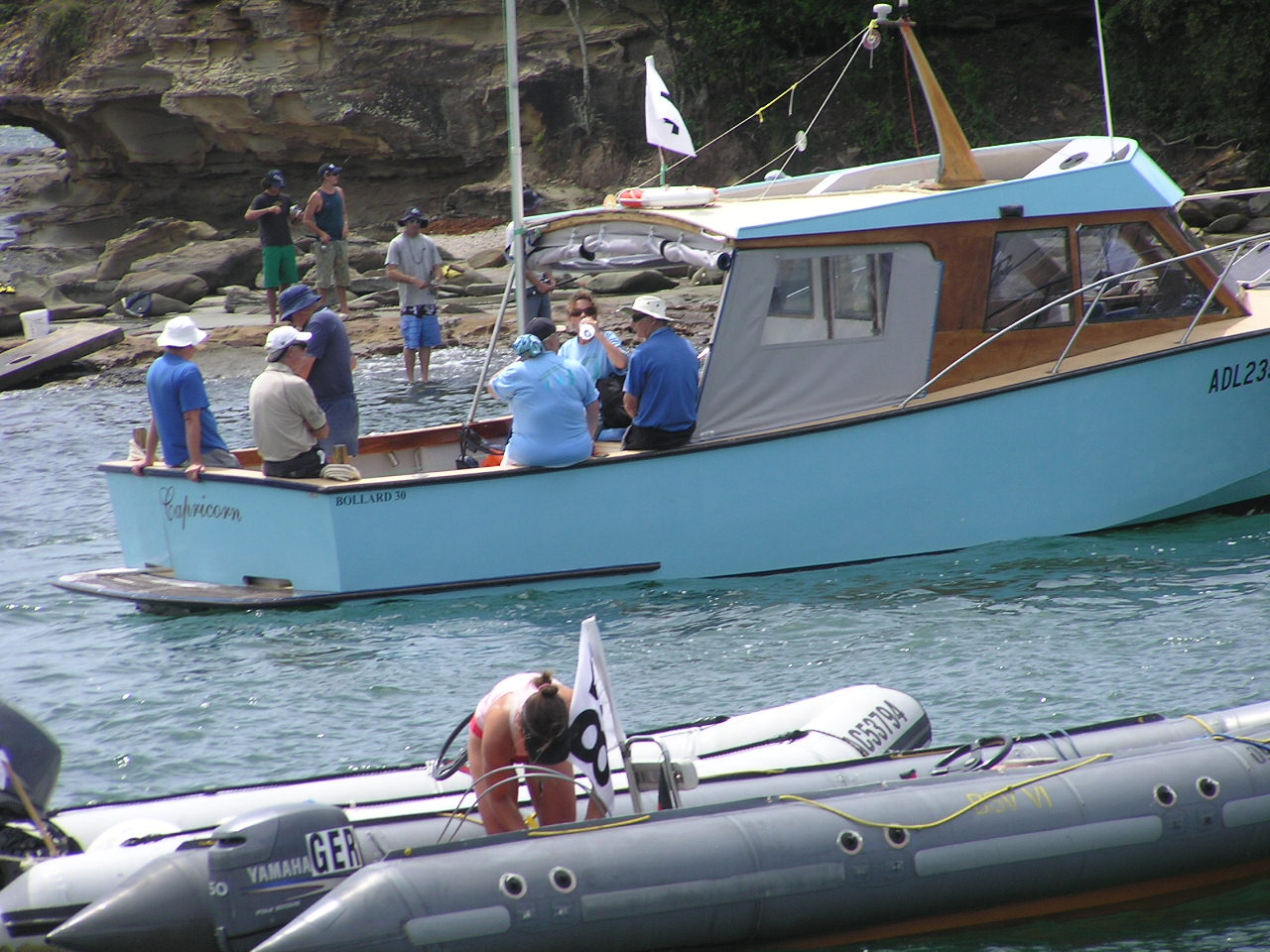
A photo of Bill’s boat taken at the Laser Worlds at Terrigal in the 07 08 season.

Half model of our Didi 40 Cr built by Bill Bollard
Despite the forecast for no wind a light south easterly breeze sprang up as we passed a pod of dolphins on our way to the starting area. The dolphins were enjoying the sunny Sydney day and bow riding the passing ferries and breaking off to jump out of the water.
We set the black carbon genoa with the backstay very slack to induce a bit more luff round hoping to go quicker in the light reaching conditions and it seemed to work.
At the start we had observed the first fleet get off the line cleanly and thought that our fleet would behave but it was not to be. Living edged luffed Izzi in front of us right up to the start boat leaving us two second short of being able to bear away for the line on the gun. The go round was expensive as we were last off the line alongside Rainbow for a long loose work to the top mark just inside the Sow and Pigs. The work back to Rose Bay via Steel Point was tighter and here we picked up the back half of the fleet in the shifty conditions around the point. Into Rose Bay we crossed tack with Rainbow a few times until going our different ways to the far corners of the Bay and coming out almost on par. Crackerjack suffered in light air on the wrong side of the bay and fell well behind.
On the broad reach to the finish line we did better closer into shore than the fleet and made up ground passing Izzi and almost catching Rainbow.
The handicap result was a fifth place with a casual in the mix so we will score four points for the day. This is an excellent result considering the time given away at the start.

The Didi 40 Cr hull glassed and sanded with some fairing in progress

A front view of the Didi 40 Cr hull glassed and sanded.
We have been away in Canada and the USA for sailing in the World Laser Masters regatta with two fellow crew from Passion. We enjoyed the sailing and the wives enjoyed the touring so it was win win. Prior to departure we had some very wet weather and as soon as the Sun came out I caught a winter bug so in all I have had a six week break from boat building and need to make up some time. We landed back in Sydney on Saturday morning after a long flight from New York but by the afternoon I was back sanding down the fibreglass on the hull. I can recommend working in the Sun as a good cure for jet lag. After two more half days of sanding I have spent the afternoon with my long fairing battens checking for any hollows and am happy with the finish. There is still some glass weave to fill before the painting starts but I can see the light at the end of the tunnel.

Tracks from a windy West Harbour Winter Series
Four of Passion’s crew for today alighted from a flight from the USA on Saturday morning and enjoyed a windy sunny Sunday back on Sydney waters.
Just as the West Harbour Winter series started at 1:00 pm the breeze gusted to 30 knots and held around the 20 knot mark for most of the day. Off the start line we reefed the mainsail without losing much ground to our over canvassed competitors. Some of the competitors called it a day early in the afternoon so we found ourselves with just a few competitors for company. On the odd occasion we were in the lee of a hill or island the breeze did fade away but not for long. The windy conditions and short runs kept most of the spinnakers in the bag for the day and we managed 8 knots on the reach under No 2 genoa and reefed main.
Conditions were a bit too windy to take advantage of the frequent wind shifts so for most of the fleet it was a matter of sailing as best as possible and waiting for the handicap results to see how they fared.
Finally the handicap results have been posted and we scored eighth out of sixteen starters. The good news is that we are now equal first of the GFS yachts with Lisdillon the new Reichel Pugh 36 and will need to beat her in the last race for an outright win.
Passion scored a handy second on handicap behind a very slippery Izzi today.
The forecast for a north westerly breeze direction was accurate but not the strength. Instead of the ten plus knots we were greeted with drifting conditions off the start line for a tight reach to the south head. We stayed on the windward side of the fleet and were rewarded with stronger and more consistent breeze than L’eau Co and Aggrovation who were not far to leeward. L’eau Co was well in front of us when they stopped in their own calm patch and it was this patch that Aggrovation sailed into. We had Larrikin creeping up behind us and were keeping high both for the wind and for clear air. Rainbow half way between us and L’eau Co missed the calm and was able to work out just ahead of us a the turn.

Panorama photo of the spectacular double rainbow over Sydeny taken on my HTC M8 from the mooring in Woolwich
The track back was much tighter than expected as the wind was shifting left. In the distance we could see the late starting fleet with genoas poled out so we went as high as possible to have room for the approaching header. In this position we were also keeping Larrikin at bay and did so until we had to free up for Steel Point. Larrikin did go over the top and managed to pass Rainbow and keep in front for the shortened course finish in Rose Bay. Rainbow hung on to beat us over the line and only L’eau Co and Aggrovation were behind but our handicap moves us up to second place.
The breeze freshened as we rounded the finish buoy and we had the best work of the day up the harbour to find a sheltered place to drop the main and genoa.
At the mooring the setting sun peeked out below the cloud cover and produced a spectacular double rainbow and bathe the city in golden light. A picture perfect way to end the day.

Dave at the helm and Cockatoo Ferry behind
The West Harbour Race 3 was started in a 3 knot breeze which quickly decreased to nothing.
After an hour of sailing (drifting idle like Coleridge’s painted ship upon a painted ocean) Passion had covered just under one kilometre and the race officials took pity on everyone and abandoned the race.
We had a very nice day on the harbour and provided some entertainment for the ferry passengers at Cockatoo Island. The drifting fleet also presented some challenges for the ferry masters to navigate at the Muster Station Wharf on the Island. All good

Winner on the day Aggrovation
We went back to the black genoa today as the breeze was forecast to be fifteen to twenty. For the first time we poled it out on the long pole and ran downwind very successfully to be just next to Larrikin and Allegro at the turning mark.
It had been a strange day and it was about to get stranger. On the downwind leg we had done very well in the middle of the course and we were battling it out with Britannia and Larrikin for second place behind the flying tiger. Inshore the fleet was becalmed and L Eau Co who had gone further to leeward was a distant last. Then it all changed. The freshening breeze from the south carried almost all the windward fleet past us while behind L Eau Co picked up a big westerly shift and was flying down on us with their genoa poled out.
Eventually L Eau Co’s breeze came down to us and we regained some respectability against the more southerly positioned yachts who had to gybe back to the mark. At this point Larrikin had the inside overlap and managed to come in on port to claim their mark room. On rounding we tacked away before Rainbow could point up to our line and got first use of a lift and on tacking back had made up ground on the fleet.
Two tacks later we heard a crunch under the hull and I felt Passion slow markedly. The helm became heavy and I feared we had a problem with the rudder.
Immediately the fleet started to draw away and now I suspected we had picked up some fishing traps. Kevin looked over the stern and thought he saw a black line. so we started tacking more to see if we could dislodge the object than to take advantage of any wind shifts.
A kilometer up the course we were still in trouble and I suggested to the crew that we might not be able to finish the race. One more tack and I saw a log appearing behind the transom but still stuck to the rudder. I climbed onto the boarding platform and reached down to wriggle the log around and as it came away we could see why we had been slow.
Our consensus estimate is that the log was 1.5 metres long. It was definitely forked at one end with each branch around 75 mm diameter and along the length were multiple branches with an outside diameter of around 300 mm.
I don’t know if it was the fork of the log or one of the many smaller branches that was stuck on the rudder but whatever it was it stayed with us through that kilometer of windward work and multiple tacks.
The really disappointing aspect of this encounter was that it occurred during the freshest part or the day and by the time we cleared it the wind had lightened and we were sitting to leeward tacking for Steel Point surrounded by the big yachts from the Division 1s.
The surprising result from the day is that we did not finish last. Rainbow managed to find some holes up in Rose Bay and had to tack for the Point Piper rounding mark in next to no breeze while we shot the mark without the extra tack. On the final run to the shortened course finish line we had breeze from behind that made our finish a little more respectable.
Another surprise of the day was the second place to L Eau Co who had been stone motherless last out the back on the first run but recovered with the fresh westerly breeze on the run and picked up another westerly shift on the work back. Aggrovation sailed well without any of our dramas to score a well earned first on handicap.
The unseasonally warm weather has been ideal for glassing the hull of our Didi 40 Cr. As of this evening just over half of the hull is covered with 425 gram double bias glass and two or three fine days should see the task finished.
I am mixing enough resin for a resin to glass ratio of 1.67 and generally have a tiny amount of resin over. The glass content is 37% and with these properties the thickness should be 0.75 mm. With this amount of resin I can completely wet out the glass and the laminate should provide both structural strength and water proofing for the plywood for years to come.

Just over half of the hull of our Didi 40 Cr is now covered in 425 gram double bias glass in West system epoxy resin
Today I put the first section of the 425 gram double bias glass cloth on the exterior of our Didi 40 Cr. It seems a long process to get to this stage from the initial fairing some many weeks ago. All the finishing steps like fitting the stem, adding the 2 mm of glass in the keel floor area under the keel shoe, fitting and shaping the keel shoe, drilling the keel bolt holes, planing the ‘V’ of the bottom and adding back the 9 mm ply layer and then shaping that back to the ‘V’ all takes time. As well I left the glass reinforcement of the exterior side of the butt joins in the plywood to the last so that there would be a good chemical bond as well as physical bond to the overlying glass.
Today’s task was the last layer of glass over the keel shoe, and glassing the last two butt joins. After a break for a late morning coffee it was back to final fairing of the stern section and sanding all the weathered timber from the plywood so that the glass was onto a clean sanded surface.
Next task was to make sure the new ‘V’ on the bottom was exactly on the centre line and straight and that needed some fine adjustment with a sanding board loaded up with some 36 grit abrasive. Some final torture boarding of the radius chine finished me off as far as physical activity for the day was concerned. Finally the time came for the first layer of glass. Then it was mix the epoxy and spread the epoxy then roll it out evenly with a foam roller then roll the glass onto the resin squeezing it flat with a plastic spreader as it was rolled out. This process went surprisingly well as the surface is very flat and the glass rolled onto a cardboard tube was well behaved.
Once the glass was well rolled down with the bubble pricking roller the last of the resin was rolled onto the surface and then spread again with the plastic spreader. With all the bubbles removed the peel ply was rolled out using a second cardboard tube and it went equally well. Using the plastic spreader again all the air bubbles between the peel ply and the glass were spread out an in the process the laminate smoothed out reasonably well.

A butt join grooved ready for the reinforcing glass

A butt join with 1.2 kg of glass per m2 across the join and covered in peel ply

A butt join across the bottom of the hull with continuous glass from radius chine to radius chine
Wednesday was another light day with just enough breeze for a full length course in chilly conditions.
Again we sailed well downwind with our big genoa poled out but with more breeze around than last week we were mid fleet at the turning mark for the long beat home.
The breeze was forecast to swing left so I wanted to be on the shore side of the course on the beat back. As luck would have L Eau Co and Mercedes IV went right and got more breeze and a big right hander to bring them out well ahead of us.
We had a duel with Rainbow and Agrovation to get to the finish line first. We had Rainbow pinned below us on port going to the finish line but he pulled away enough to attempt a tack onto Starboard and I was unsure if he would clear us so I took the precaution of tacking below him but in the process could not make the finish line on Starboard. The line was so biased to the boat there was only room for a single yacht on starboard to pass the line so we had to wait for Agrovation to come steaming in behind Rainbow before we could tack to port for the cross. The maneuver cost us a minute and a half and one place on handicap but it was worth a lot more in the pride stakes.
With hindsight I should have headed away while on port giving Rainbow no room to tack to the finish line and that is what will happen next time. The alternative of playing chicken and having a collision with them mid tack is not worth the angst.
I am a fan of the West Harbour Winter series conducted in the area between Goat Island to the east and Schnapper and Spectacle Islands to the west. This is our second season and with every race the crew is more comfortable with launching and retrieving our big red white and blue spinnaker and in gybing it downwind.
Today was a typical event conducted in a light westerly breeze well below the forecast fifteen knots. Both our yacht instruments and the weather bureau seem to agree it was about seven knots at the good times.
We started near the boat and gave way to yachts that by rights we should have forced into the committee boat. For our efforts one crossed early and was disqualified for not returning but we had to eat the dirty air up the first work. The breeze swung to the right favouring the more northerly positioned yachts and that was not us so we had to tack away from the lifts on two occasions which do not look pretty on the chart plot of our course. As the day went on the breeze swung more to the north so the second work along the Hunters Hill shore was a single beat compared to the zig zag tracks of the first work.

Our tracks around the second heat of the West Harbour Winter series
The fun bits were flying the spinnaker around Schnapper Island and then carrying it tight along the Balmain shore.
Our twilight competitors Saorise and French Connections were left well behind on the first work and I assume they did not have spinnakers flying by the look of the elapsed times. A few light weight flyers from the blue division caught us and Gwhizz took a minute out of our time in conditions that suited them. The J 70 caught us on the downwind legs but we managed to stay with them from Goat Island all the way back to the finish line.
The last run to the shortened course finish line was very square and our big symmetric spinnaker worked better than the asymmetric on the J 70 as the conditions were too light for her to get up and plane.
Our sixth place on handicap was pleasing as was our elapsed time compared to our regular competition.
Today was spent planing back the ply doubler on the backbone to reestablish the “V” shape on the bottom.
Even with the aid of the Makita power planer it was still a lengthy job and much hand planing was needed for the final adjustment.

Power and hand planers make a lot of wood chips reestablishing the “V” on the bottom of our Didi 40 CR
I managed to finish from the keel to the transom including belt sanding the doubler to make sure it was flush with the ply bottom. Tomorrow weather permitting I will try to finish section from the keel to the stem.

The completed stern section of the backbone “V” of our Didi 40 Cr ready for final torture boarding

Dave in concentration mode on the day
In drifting conditions we scored first on handicap today. The conditions were ideal for Passion as we were able to pole out the big genoa to leeward at first and then to windward later on the downwind leg and the windward work was a short one to the shortened course finish line.
We started well at the boat end in less tide than the windward yachts and maintained our position near the front of the fleet for the downwind leg. Several times our competitors crossed us looking for breeze on one side of the course or the other while we kept a more conservative track. I moved the sailing angle around with the breeze quite aggressively to keep the air flowing over the genoa and that seemed to pay off rather more that chasing the breeze on the sides of the course. Amanti, Allegro and Larrikin all crossed within metres of us but suffered by going in too close the south head shore.
Fidelis managed to get out in front criss crossing the rhumb line while Britannia managed to pass us with a similar pole out to leeward and windward strategy. When I say pass us they just had the clear ahead position at the turning mark as we had to swing wide to avoid them. That allowed Allegro to round tighter and sail over the top of us on the windward return to a very shortened course. Kevin spotted a lift ahead so we tacked for the breeze and managed to cover most of the fleet. The extra width to windward allowed us to keep Passion moving to the finish line just ahead of Agrovation. In the short work to the finish line Allegro gained a minute and twenty seconds on us which shows how well she travels to windward.
For the first time ever we beat Amanti, a Sydney 36 cr over the line so we knew we would have a good handicap result. Agrovation managed a good second on handicap so it was a good day for the Jeanneaus.
The hardwood shoe which fits between the hull and the steel keel is fitted to the hull. It sits on top of a 2 mm thick layer of high strength epoxy glass which is part of the additional reinforcement I have included in the construction of our Didi 40 CR. I had already drilled pilot holes for the keel bolts but I checked and rechecked every part of the way as I drilled the full size 25 mm holes through the keel and keel support frames.

Checking the keel bolt hole alignment before gluing the hardwood shoe to the hull.
It took the best part of a day and a half to drill the eight holes, fasten the hardwood shoe down with two of the keel bolts and prepare the plywood capping for the centre line reinforcement. The photo shows the two keel bolts temporarily holding the keel shoe until the glue dries. The bolt have been wound around with packaging tape so that they come out to the full diameter of the holes and there is no movement of the shoe while glue sets. The packaging tape is also excellent mould release material and the bolts should be able to be removed even if some epoxy had oozed onto the tape.

The keel shoe glued in place on top of the large area of mm thick glass reinforcement

One of the keel bolts temporarily holding the keel shoe while the glue cures.
The plywood capping pieces have to be shaped around the keel and also splice joined along the length so it took a couple of hours to do that effectively. Tomorrow the plywood will be glued down ready for the final shaping back to the original hull “V”. Also completed is the reinforcement where the 70 mm diameter stainless steel rudder shaft goes through the backbone. Two pieces of spotted gum hardwood have been glued in either side of the backbone making a very solid structure to support the loads on the rudder shaft.

Two 75 by 30 hardwood doublers reinforce the backbone where the rudder post will exit