
Morning tea mid way through the turning party for our Didi 40 Cr

Didi 40 Cr at the tipping point in the hull turnover process

Didi 40 Cr well on the way to being right side up

Now the Didi 40 Cr just needs to lowered onto the cradle

The turnover party crew

Early progress on turning our Didi 40 Cr
The turn over of our Didi 40 Cr hull went according to plan today. I was confident enough to invite people to come and help and watch but nervous nevertheless. We started the job right on 10 am and used the chain blocks to lift one side of the hull. The rope wrapped four time around the hull was meant to turn the boat but it kept slipping on the shiny painted surface so we used the chain plate frames as attachment points for the turning ropes. Once we had a firm pull on the hull it turned readily in the slings. Soon our main concern was preventing it toppling over once the centre of gravity went over the top. Again rope attached to the chain plate frames was used as a steady as the hull slipped slowly in the slings into the upright position.
Once the hull was level it was time for a break and to celebrate with a sip of champagne.
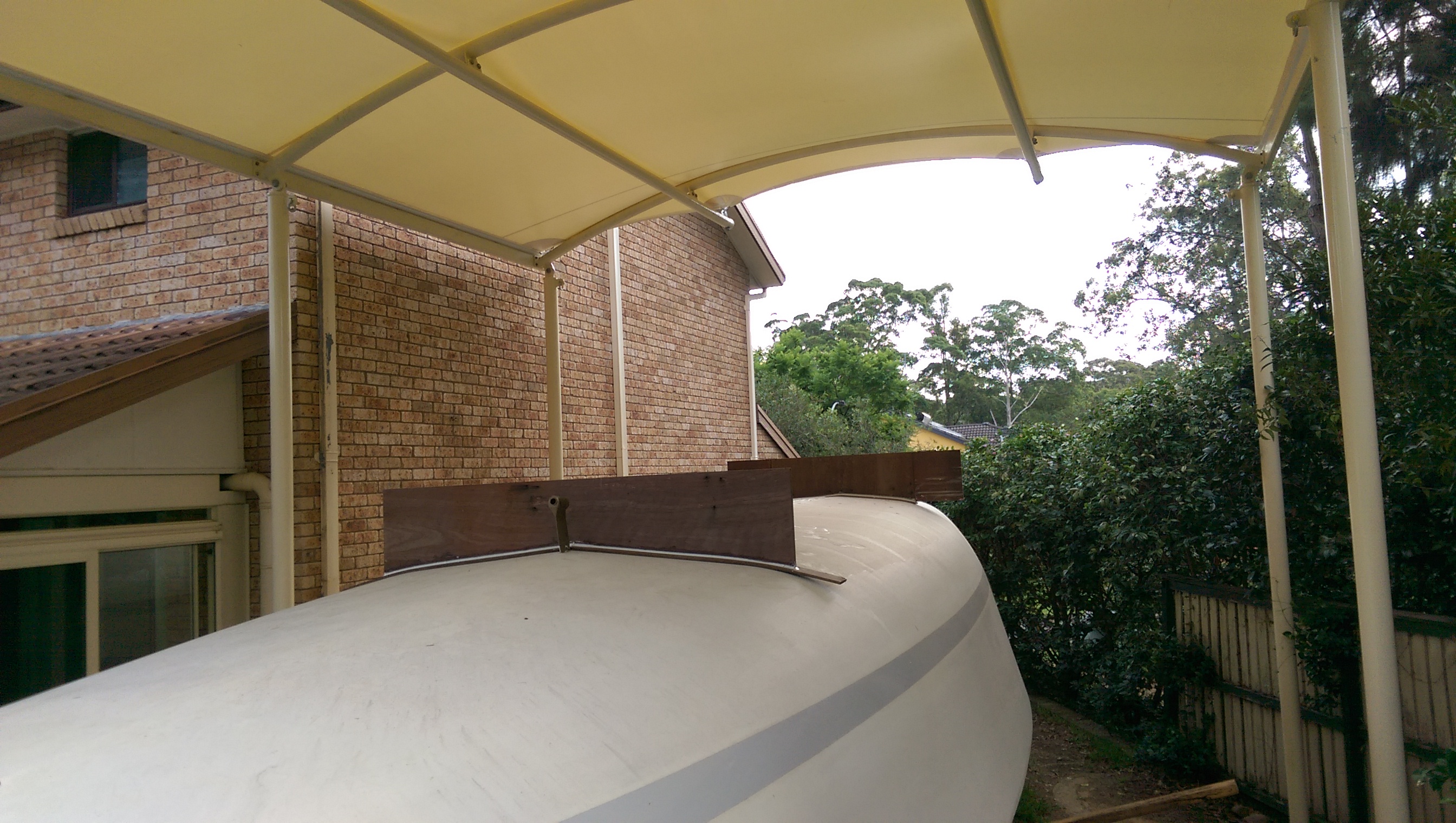
Tonight there are tarpaulins over the bow and stern where the hull protrudes from under the awning.
Today I liberated the DIdi 40 Cr hull from the building frame in preparation for turning it on Monday. The task went to plan and I applied just enough tension on the chain blocks that connected to the slings holding the hull so that the hull did not slip lower on the frame. As I progressed from stern to bow I had released eight of the twelve supports before the supports started to lift away from the reference marks.
Once all the supports were released I raised the hull high enough to fit the rear cradle to the building frame. That will be completed tomorrow in time for the turn on Monday.
Another milestone of sorts was completing the wet sanding of the International Interprotect two pack epoxy primer on the hull below the water line. I figured it was easier to sand while the hull was upside down. The environmental dust that had settled on the hull was a good sanding guide and the more I sanded the cleaner and more slippery the hull became. For the last section today I was worried about sliding off the hull and thinking of the song “Slip Sliding Away.” It is corny I know but one of the names I had thought about for the boat was “Destination” and the song goes “The nearer your destination the more you go slip sliding away”

A slippery looking hull when washed down to keep the dust from annoying the neighbours

Yes it is starting to lift off the building frame.

Just a one hand pull on the one tonne chain block to lift the stern of our Didi 40 Cr

The aft cradle is positioned ready for level measurement and securing to the building frame.
The warm night and light breeze tempted a large crowd to stay for the post race BBQ at the Greenwich Flying Squadron. Hopefully the pleasant atmosphere and good food made up for the disappointment of some of the crews who found themselves a few hundred metres short of the finish line when the breeze died. Indeed at 10 pm when I was putting Passion back on the mooring at Woolwich there was no detectable breeze.
Sitting on the start line like a Laser does not work for a 6,400 kg yacht and so we were passed by Gwhizz and Saoirse to leeward and Izzi to windward. While we made the tight reach into Humbug in good order once we turned for the broad reach to Cockatoo Island we were blanketed by the following fleet. In one of our least successful downwind legs we were passed by the whole fleet. Normally we would give Cockatoo Island a wide berth but the wind was still fresh and we had the full rig up so I chanced a line a little closer that usual and we were rewarded with a lift above the tail enders. Now we had an outgoing tide to help and after crossing tacks twice with French Connection we ended up on the right side of a lift which gave us a good gap. In front we had Tartan, Saoirse, Worlds Apart, Izzi and Gwhizz to catch and they were a long way in front.
In the beat around Goat Island we passed Tartan who stayed on our hip all the way back to Humbug. Worlds Apart with their distinctive large mainsail with the Jeanneau logo was not far ahead and Saoirse was in between. Izzi was up near Worlds Apart and finished ten seconds in front of her while G Whizz was out in front all alone. Luckily for us Saoirse and Tartan went too close in to Greenwich and slowed in the wind shadow. By the time they escaped from the windless zone we were well away and enough away to beat them on handicap. The rest of the fleet struggled home in dying breeze so the early finishers were the handicap winners on the night. For our troubles we collected the mandatory bottle of wind at the results presentation.

Light airs and an outgoing tide produce some good tacking angles.
Cannot resist a photo of the access stairs now that I have a second coat of clear epoxy on them. Also a close up of the quality of the plywood used in the stairs and also in the hull.
Another alteration I have installed is 12 mm plywood reinforcement over the keel in two places where there is a splice join. Dudley’s plan already has plywood across the centre line join down the keel on the outside of the hull. This provides considerable cross grain strength to the keel. I have added the 12 mm plywood to give cross grain strength in the inside of the keel as well as stiffness along the section. So effectively there is a sandwich construction with ply on both sides of the meranti keel. Each 12 mm piece of plywood weights approx 2 kg so for 4 kg additional weight low down on the keel I get a lot of insurance. I added these because the meranti backbone has a massive amount of cross grain reinforcement in the keel floor area and then nothing extra in the quite wide spans between the frames fore and aft of the keel.

No worries about cross grain strength in the keel floor area. The laminated frames are 110 mm wide where they cross the meranti backbone

An interior layer of 12 mm plywood for cross grain strength for the keel (backbone) of our Didi 40 Cr

12 mm plywood reinforcement across the keel at a splice join in the meranti backbone.

The companionway stairs for our Didi 40 Cr already looking good with just two coats of clear epoxy. More to come.

A close up of the 24 mm thick plywood stairs construction. This is the same plywood used in the hull of our Didi 40 Cr in 12 mm thickness.
We have another short week for boat building so I am doing fill in jobs. Today I made the access ladder which will be very handy once the hull is turned and another job off the list. Yesterday I skipped sailing the Laser and glued up some 12 mm plywood to make 24 mm plywood planks for the steps and rails. It took all of today to shape the components and glue them together. The photo shows some temporary cross bracing to keep the structure square until the glue cures.
The plans for the Didi 40 Cr comprise the original plans for the Didi 38 plus some additional frame details for the extended Didi 40 Cr. The ladder is further aft in the Didi 40 Cr so some adjustment to the profile shown in the Didi 38 was needed. I also measured up the stairs on our Sun Odyssey 37, Passion, and was surprised to find that the tread depth and height are exactly the same. Passion’s treads are made from 24 mm ply so I thought I would do the same on the new boat.
I had considered installing the water heater under the stairs but there is not enough space. The bottom of the wet locker in the head is however the right size and it will make the bottom of the locker a similar depth to Passion.
Most days I spend a couple of hours sanding the roller pattern off the last coat of Interprotect. It has cured to a very hard surface so I should have done this job within three days of the last coat.

The access ladder for our Didi 40 Cr.
Tonight was all about avoiding mistakes. The north east breeze was forecast to die out before a late southerly front so we set the large black genoa in anticipation that by the time we had run down the south side of Cockatoo Island the breeze would have abated. The sail selection worked to plan as we won the race out of Humbug. We were aided in no small part by Gwhizz going high under the Greenwich hill and carrying Worlds Apart and Agrovation with her. French Connection and Izzi went low as we did and we three emerged well in front of the pack. Izzi won the run down the south side of Cockatoo but only by a couple of boat lengths. She undid all her good work by taking the corner at Schnapper Island so close that she ran aground and we had to take avoiding action.
Izzi’s problem left us with a small gap to French Connection and with Saoirse stopping to assist Izzi there was one less close follower.
On the beat back to Goat Island French Connection got on the winning side of one shift to make up ground but then went off to the north while we played the shifts up the track.
From the approach to Goat Island all the way back to Greenwich Flying Squadron we had to contend with light shifty conditions. All the time we could see Worlds Apart making ground on us only to fall into the same quiet patch we had just traversed and so the lead widened again. As we crossed the line the southerly started to come through bringing the back markers through the fleet with speed so Gwhizz was a close second and Farrst Company made up a lot of ground to give her a handicap chance.

Respectable tacking angles on a quiet night
I missed my self imposed deadline of the end of January to turn the hull partly due to wet weather but more to do with family matters which will keep us occupied this week. There is no rush to turn the hull and leave the inside exposed to the elements and I have a lot of jobs that can still be completed with the hull upside down. Today was a big sanding and painting day and now the huge aft locker is coated with two coats of white epoxy primer on top of the two or three coats of clear epoxy. Not only is the timber more protected but the interior is lightened up considerably.
I have rigged up one of the slings to lift the hull and used the two tonne chain block to take up the load. It is so tempting to fit the other sling and lift the hull but I will be patient.

A view across the area where the rudder stock will go. The steering quadrant for the autopilot will go on the rudder stock in this area.

You can see how the widened aft cockpit reduces the volume of the locker but there is still plenty of volume and enough full length area for the long items.

A view through the companionway. I will need the ladder soon to get into and out of the hull.
On Wednesday I took a chance against the forecast and glued on the last 12 mm panel on the transom below the boarding platform. For good measure I sealed the ply edges with thickened epoxy to keep out any moisture overnight. Today I trimmed the surplus ply on the underside again epoxy saturated the edges and face of the ply with wet on wet coats of fast cure part B. The cure beat the thunderstorm that rolled through late in the afternoon.
I managed a coat of epoxy primer in the locker and have just one small section behind the quarter berth to sand and prime. It is already double coated with epoxy and the white primer is to improve the light in the dark corners of the hull.
In between jobs I bogged some 100 mm wide 12 mm ply strips to the top of the frames I am building to support the hull after the turn. Tomorrow I will add a couple of layers of glass for good measure and then pre drill the frame ready to bolt to some solid LVL planks.
Two support frames of 24 mm ply shaped to the hull and with 100 mm wide ply planks to spread the load.

The last panel of 12 mm ply glued to the transom of our Didi 40 Cr. It is faired on the underside and saturated with epoxy resin.

A closer look at the stern support for our Didi 40 Cr. I must remember to drill the hole in the frame for the prop shaft
Our No 2 genoa started life as a cross cut flex kevlar laminate with taffeta on one side and we had some good races with it but I felt the flow migrated too far aft. We had the sail retro fitted with carbon strings and that has made it into a very stable shape sail which we use in over fifteen knots of breeze. Over the season I have progressively moved the genoa cars further forward and that has helped with more drive low down and more even streaming of the tell tales. The clew now hugs the deck and while the sail is only 35% overlap we seem to generate good speed with it. As the overlap is shorter we can tack faster and that was put to good use on Wednesday night.
We made a good start although Kevin said we could have fitted the whole Laser fleet between us and the line at the gun. Despite that we crossed the line with speed and made it first into Humbug. The last we saw of Jedi was Ray telling us the course before he took off for another fastest time. Worlds Apart powered over the top of us off Greenwich Yacht Club so we had to follow in their dirty air. On straight line speed Izzi was below and in front and French Connection above and behind but not for long. French Connection used the height to advantage approaching the navigation mark off Goat Island while the rest of us slowed pinching to avoid a tack. By avoiding the tack we passed Izzi and managed to stay in front for the night. Around Goat Island I sailed high enough to stop Izzi going over the top but Farrst Company sailed through to leeward and Worlds Apart and French Connection opened up a sizable lead. In the run back around Cockatoo Island we sailed low and slightly be the lee to keep clear air and were able to pass Farrst Company and keep Izzi at bay.
The work back to Humbug and the finish line was where the ability to tack the No 2 genoa was put to good use. With Kevin calling the shifts we tacked on the headers and made up the sizable lead that French Connection had established around Goat Island. At the same time we drew away from Izzi and Saoirse. Farrst Company had a little altercation and did a 720 which put paid to her handicap chances for the night and explains why she dropped so far behind. Agrovation will have a clean bottom next week and will be back in form.

The wind record at Sydney Airport for the evening of our twilight race
What a difference a day makes. Contrary to forecast the day was perfect for boat building and gluing in particular. I was still thinking of my friend Bruce who was retrieved intact from the briney last weekend and the importance of a good boarding ladder so I added a second 12 mm ply reinforcing panel to give a total of 36 mm of plywood to screw into. Gluing conditions were so good that I was able to add this extra reinforcement and still install the boarding platform and have the glue cured before dark. With the afternoon sun streaming into the garage I was forced to share the pleasant working conditions with a lizard which would scurry away every time I returned. In the company of the lizard I managed to cut out panels of 12 mm ply which were then glued together to make 24 mm frames for the cradle i will need when the hull is turned.
All of the interior painting I propose to do before turning the hull is complete and I can now install the bracing across the hull to add strength for the turning process. There is still half a day of painting to do in the huge aft locker and other Jobs I can do while waiting for timber and a good weather forecast.

Perfect, even idyllic conditions for boat building on Australia Day 2016

The boarding platform includes a 36 mm thick section for fastening the boarding ladder

The last of the feature panels has three coats of clear epoxy.

The 24 mm thick plywood frames that will be part of the cradle for our Didi 40 Cr

Some of the lifting gear waiting to be put into action.

Three extra circuit breakers added to our 12 volt distribution panel.

The tank selection valves to switch between the two 300 liter water tanks.
The high humidity is putting paid to my high hopes of turning the new yacht this month. The forecast for the rest of the week is for a lot more rain and that will not help. During the downpours I have gone shopping and stocked up on epoxy resin and paint. All the timber for the deck has been ordered but it will need dressing and sawing to size. I have bought and added three extra circuit breakers to my switch panel, bought conduit for the cable duct that will go through the refrigerator and bought the bolts needed to secure the engine mounts. In all there are sixteen bolts which will have heads under the engine so I am tack welding them to the mounting frame so that the nuts can be tightened up without getting under the engine. At least the welding can be done under cover from the rain.
I keep finding jobs that are better done now as they will be impossible later. A case in point is the ladder on the boarding platform. The ladder will have to be secured to the platform but once the platform is glued in place there would be no way to add reinforcing behind. So that means deciding on the boarding ladder to use and pre installing the reinforcing. I was reminded how important is this feature when a friend fell overboard from a yacht last weekend and was retelling the tale after sailing on Saturday. He described how hard it was to get back onto the yacht without a ladder. A little unit from Whitworths looks very sturdy and has six fastening screws and should do the job nicely.
Another job that was better done with the hull upside down was the base plate to hold the refrigerator compressor unit. It is not a big job but needed a couple of timber cleats set level. The plan is to screw the compressor to a 12 mm ply base and slide the base into position on the new cleats.
After discussion at the local club I decided to install doors on the two large bottom lockers. There is one in each of the front berth ante room and quarter berth ante room and adding doors will allow us to store heavy items low down. Today I purchased some hinges and latches so if the wet weather continues there is another job I can do.
The words of our former Twilight Captain were true again on last Wednesday when the last placed yacht in one division was awarded a prize. If Mark had not been there would we have awarded the prize to the yacht that did not finish? Yes we too won a prize courtesy of better performing yachts whose crews did not return to the club for the most enjoyable BBQ.
The race was pretty uneventful in our division except that this week Izzi got the better of us on fastest time to push us back to fifth fastest. The results do not show this but will in time be corrected and Izzi may well jump to second on handicap for the night.
The black fleet had an interesting start with one yacht starting her motor to avoid a collision and then doing turns and restarting. I agree with the principle that yachts should be able to use motors to avoid collisions but the RRS require that we specify this in our sailing instructions (rule 42.3 (i). Oh well I did say it was social sailing.

12 mm plywood webs support the boarding platform on our Didi 40 Cr

Close up of the plywood webs and epoxy fillets prior to three coats of West System epoxy resin

The last 12 mm plywood capping piece on the stern of our Didi 40 Cr

The underside of the 12 mm plywood boarding platform is saturated with three coats of West System epoxy
Only ten days to complete my job list before turning the hull! Top of the list is completing the boarding platform as this provides structural strength to the overhang from the transom. I allowed two days for this task and already it is six days but I have managed to fit in some of the other jobs. Apart from the timber work to support the boarding platform I have put epoxy fillets in the transom to hull join and in the boarding platform to hull join. Then all the new timber needed three coats of West epoxy to water proof the hull. Even the underside of the 12 mm ply boarding platform had to be coated as this area will be inaccessible after completion.
The Summer series at Greenwich Flying Squadron twilight races is a separate series that does not count towards the overall season result. Under these circumstances it is easier to be charitable to our fellow sailors when then luff above head to wind and tack on top of you on the line. Meanwhile the fleet disappears around Onion Point as we struggle to build up enough speed for the rudder to work. No one it seems bothered to take a penalty for a collision to leeward so indeed it must be social sailing. It is surprising how fast the back of the fleet can sail especially when they are on the right side of a few large wind shifts. I discovered this when we had to tack onto port at the line of moored yacht near the Woolwich marina. To avoid the following parade of starboard tackers we had to go the long way around back where we came from and away from the big lift along the Hunters Hill shore. The tracks from the chartplotter show the zig zag progress on the first leg up the Hunter Hill shore compared to the straight line on the second time around. To add to our woes for the evening we experienced a 20 degree header just as we cleared Long Nose point on the way to Goat Island.

Contrasting windward works up the Hunters Hill shore line
By Goat Island we had worked up into the tail of the fleet and were just ahead of French Connection and still in contact with Farrst Company and Izzi. We did quite well on the reach and run back to Cockatoo Island and did our normal wide sweep of the wind shadow in the lee of the island. To our surprise the competitors who took the inside running kept breeze the whole way around so we hardened up at the tail of the fleet again. That was the end of the unexpected wind patterns for the evening. Our work up Humbug was efficient so that by the finish we had put Izzi, Fast Company and French Connection behind us and some order seemed to have been restored in our sailing universe. We had in the finish only a minute and a half deficit on Worlds Apart and were in turn a similar amount of time in front of Izzi. While nothing could save us from a second last on handicap the fourth fastest was some consolation considering the adversities of the evening. A lot went right on the day. I had spent a good morning working on the new build and still found time to pick up some parts for Passion and do a repair to the head. The evening on the deck at GFS was enjoyed by a large crowd in very pleasant weather and the trip back to the mooring after the raft up was in very light conditions. We were very fortunate with the weather as the conditions the following day would have made sailing and the function impossible.

Strong winds on Thursday would have made sailing difficult
In the march towards turning the hull of our Didi 40 Cr I have a long list of jobs that I would prefer to complete while the hull is still upside down. I have trimmed the excess ply form the gunwhales and double coated ply edge and gunwhale with clear epoxy. It is not the final trim but is enough to provide a smooth edge to assist the rotation of the hull when supported in slings. With the excess ply removed the hull looks more finished hence less is better.

Gunwhales of our Didi 40 Cr trimmed and coated with clear epoxy
As I have progressed with painting the interior there is less dark plywood and more white surfaces and again less dark surfaces is much better. Only the locker and the section that houses the steering quadrant have yet to be painted. These are double and triple coated with clear epoxy so the white two pack primer is more for light than for protection and at a pinch I could leave this area until after the turn.
When I have thought ahead I have masked off areas which will have cleats for the floor and deck. Elsewhere I have painted the surfaces knowing that a quick hit with the high speed angle grinder and coarse sanding pad will prepare the surface for epoxy glue.

Two coats of two pack epoxy primer in the companionway of our Didi 40 Cr brighten up the interior
The keel bolt holes have had their third saturation with clear epoxy. I sealed off the holes from the inside with wooden tapered plugs and filled the holes from above with epoxy. After three thorough drenchings with clear epoxy I am confident that all the end grain in the holes has been filled.

Keel bolt holes of our Didi 40 Cr after three saturations with clear epoxy.