For the last two weeks we have managed to achieve fastest times in our Blue Division at Greenwich due to good starts and a clear run through Humbug. Last week our seeming race winning lead was extinguished by a new breeze coming down the course and only a lucky gust at the finish saved us. This week we escaped Humbug on the way out in a similar fashion and managed to hold onto a two minute lead all the way. At the start the breeze was a bit more East than last week and we could not make the start line of starboard if we sailed up the Lane Cove River. We had to run back to the fleet and gybe before the line of moored yachts so that we sat higher than all the fleet. With the bias on the line we had a good lead and could tack onto starboard at will. Even with freedom to tack we just shaved Onion Point of the way out which saved us a few more seconds. On the work back to Goat Island we were on the wrong side of two shifts off Greenwich and did not get back into phase with the changes until we settled into a longer leg along Snails Bay. I begged for wind to get above the concrete dolphins and we got just enough angle so that Frank, putting in a welcome guest appearance, could not reach out and touch it. A timely involuntary round up turned into a tack and had us back in phase. Worlds Apart was no longer steaming up to our stern as she had been coming into Long Nose.
We sort of held our own for the run back around Cockatoo Island with the only real excitement being a late swerve to windward to avoid the protruding yard arm of the monster moored at the South East corner of Cockatoo. I heard another yacht in the fleet made contact so I am grateful for the advance warning I had from the crew.
Back into Humbug we could see the earlier starters becalmed so we went below all the fleet and managed to shave Onions Point on the way back in.
So all was well on the last race of the season and we won the handicap as well.
The Christmas BBQ back at Greenwich was well attended by and well enjoyed by all with some very excellent prizes for the raffle donated by the generous sponsors. As much as I willed it Keith did not pull one of my numbers out of the hat and I had to go home without the Helly Hansen wet weather gear or the Back Vintage wind selection or the Wild Oats bags but we did win one of Back Vintage wines for our handicap win.
Last week we struggled all around the course buried mid fleet and without any lucky breaks. An involuntary gybe at the corner of Cockatoo Island caused be a wind eddy forced us too close along the shore from where we never recovered. We were too close in at the West end of Cockatoo Island and caught in the wind shadow. Tacking back through Humbug we could not get into phase with the shifts and had a pretty average result.
This week was a different story. We set the No 2 genoa in anticipation of a southerly front which came through just as the fleet was starting. The smaller overlap and more comfortable sail area meant we were quick to windward and tidy in the tacks. From the first tack we had Worlds Apart covered with Agrovation behind her. With clear air we could pick our course and at the same time keep a loose cover on Worlds Apart and an eye on Agrovation.
We did not see the rest of the fleet after we rounded Cockatoo Island and were enjoying our time at the lead. Agrovation sailed into the wind shadow off Long Nose and around Goat Island we managed to stretch out the lead on Worlds Apart when they were caught in a light spot in the lee of Goat.
The breeze had dropped away to seven knots as we approached Greenwich when it freshened from the South bringing Worlds Apart charging up to us and past us. There was little we could do as the breeze we were in was lighter and tighter and until the fresh breeze arrived we could not pole the genoa out to windward. Once Worlds Apart was past us we managed to get the genoa drawing and sat on their stern blanketing them as much as possible as we entered Humbug. Luck was back on our side as a fresh gust from behind gave us an inside overlap at Onions Point and with a dead square run to the finish we all had clear air. Being to leeward boat the angle of the finish line favoured us and we reclaimed the fastest times win by a quarter of a boat length. While we could see only Worlds Apart and Agrovation at the finish the freshening breeze brought all the fleet home and despite that we managed a third on handicap.

Galley furniture in our Didi 40 Cr taking shape with sink and ice box openings cut.
I have been pushing ahead with the engine compartment and galley so that I can get the floor levels and edge support in these areas established. So the engine compartment is temporarily installed with screws so that I can remove it from the hull for painting and fitting of the insulation. While it is out I will fit the foam to the fridge so there is a bit of work piling up. With the engine compartment in place I fitted the companionway floor supports and fitted the first floor panel. It was a good fit but the surface was a bit too slippery and the feet of the ladder slipped before I had a chance to install some cleats. The result was a nasty fall down the companionway with my body inside and my arm outside so I have a couple of bruised ribs and a forced rest. There were lots of cleats in the engine compartment and galley to be glued and that was a good light task for my condition. I even managed to install the sliding doors behind the stove and fridge. While doing these jobs I thank my father Ted for his example of wood work and all the skills I picked up from watching him. Still in search of light duties I mapped out the drawers for the galley and settled on three narrow drawers and one deep one. I cut the surrounds and rails on the circular saw bench and did a trial fit with a couple of 9 mm ply panels that will be the 18 mm thick drawer fronts. I was so pleased with my first floor panel in the companionway that I put up with a bit of pain to cut out the panel that runs down the side of the engine compartment to the settee area. It is trimmed and fitted now and provides a nice unobstructed route through the hull. That was the last of the 12 mm plywood so I will have to order another two sheets to finish the balance of the floors. I must paint the battery compartment as a matter of priority so that I can install the first couple of batteries and get the electrics under way. I will remake the instrument panel as the 6 mm ply I used was too floppy and distorted. I have some very nice seven ply 9 mm sheets that will do the job well.

Sliding doors behind the stove and ice box are completed but for painting.

The one piece removable end for the engine compartment fits nicely and the floor from the companionway to the sitting area is now in place

“U” shaped dining area structure in our Didi 40 Cr is now completed

Floor in the dining area and false floors inside the seats are fitted.

Galley panels for our Didi 40 Cr are cut and waiting for cleats to be fitted.

The hardwood rails for the galley sliding doors will go in this space behind the fridge and stove. I broke one router bit on the first few centimetres so reverted to the circular saw to cut the grooves.
After several weeks where tedious fibreglassing took up most of the time I am now building in furniture from plywood sheets. The first structure was the extra seats that form the “U” shaped sitting area. The front seat is for general storage while the back seat will house the battery bank. The structures are built, the false floors added and the lids cut. They still need to be painted and the lids hinged but the upholsterer can now measure up the last two seat cushions. With the seats in place I was able to cut the temporary plywood floor into the final shapes and add edged supports where needed.
The settee area with the new seats provided a very good working platform to start on the engine compartment and galley furniture. It is quite a tight fit with just 475 mm between the quarter berth ante room wall and the galley top and the engine enclosure cannot be any smaller. I had to cut a hole in one side of the engine enclosure to give some clearance to the bigger alternator on the new Yanmar YM30. The hole is inside a cupboard so it will not seen but it showed how tight a fit it is. I also cut holes on both sides where the nuts on the engine mounts interfere with the side panels.
Tonight all the plywood panels for the top and sides or the galley furniture are complete. I still have to cut the end panels of the engine enclosure and will make them a stitch and glue item I will edge glue the sloping and angled pieces and once cured remove it from the boat and glass the corners on the shop floor.
I have to work out the detailing of the drawers in the galley and will probably do two drawers in the top half and one big deep pots and pan drawer in the bottom half.
There is lots to do including fitting the foam into the refrigerator and making a good insulated lid for that and also fitting the sinks into the galley top. With the galley structure in place I can now start thinking about the floor support cleats.

The finished king plank on the keel of our Didi 40 Cr. It is 100 mm wider and 3 mm thicker than the original design and the extra 100 mm with is made from hardwood to spread the keel bolt loads.
I have passed another milestone with the completion of the glassing of the keel floors to the hull. Once that was completed and I cleared all the limber holes I slapped on a coat of epoxy.
While the epoxy was curing I started cutting plywood for the engine compartment and by the time I had the two sides cut the epoxy was cured.
The yacht has been so warm that I have mixed only small batches of epoxy as the pot life is very short in the hot weather. I will paint on a couple of coats of epoxy paint before we launch but I can now get on with building the seats at the ends of the settee that will go over the king plank.
The king plank has been augmented with extra hardwood down both sides to share the pressure from the keel bolts. Dudley’s detail show small packers under the keel bolt washers but I have extended these for the full length of the king plank.
The king plank sits on top of the keel and forms the top of an “I” beam. The keel and plywood skin are the bottom of the beam. The longitudinal beam spreads the forces from the keel bolts among all the floors and in particular spread the loads if the keel touches bottom at speed. The standard design has a 15 mm thick king plank and with our deep keel Dudley increased it to 18 mm thick. With the extra width of timber along the full length of the king plank we have gone from 150 mm by 15 mm to 250 mm by 18 mm and the additional 100 mm is hardwood so the beam is much stronger than the original. The shear stress in bending of the beam is taken by the six massive keel floors which at that point are 110 mm wide and 80 mm deep.
Congratulations to the Groves clan for winning the fastest times contest in the Blue fleet at Greenwich Flying Squadron. It was a tough battle between the three Jeanneau designs, Agrovation, the newer 379, Passion a 2006 Jeanneau SO37 special and the larger Worlds Apart, a 39i Performance. Agrovation was always going to be the one to beat. They have a nice set of Carbon sails and sail the boat well. Any time we can beat them we think ourselves fortunate and this was the case in the last race of the Spring series. We started in light conditions with a gust of wind in our starting sequence that ensured we all arrived at the line on time unlike the earlier fleets that had struggled to get into the starting box. We were sandwiched between Worlds Apart in front and Izzi to windward as we beat up the Greenwich shore line. We were close to the line of moored yachts when Worlds Apart tacked away leaving us clear air. To windward Izzi was preventing a free tack so we needed to go right to the prohibited zone before we could call for room to tack. We never called. Izzi tacked away when it looked like we would need to tack and suddenly we got a big gust from behind that lifted us around the last moored boat. That was the last reasonable gust for the next 20 minutes but we had a couple of knots of breeze and were out of Humbug unlike the rest of the fleet that were becalmed. We were almost at Cockatoo Island when the fleet struggled out of Humbug with new breeze from the East so while we tacked to the Island they were reaching along. I was instructed by the crew not to look behind and there were promised of blinkers for Christmas to keep me focused on where we were going. On the beat to Goat Island Agrovation took the Greenwich shore and seemed to be going at twice our speed. Once past Long Nose we were in similar fresher wind and we seemed to hold our own. It was look behind for all the run back to Humbug and I was relieved when we made it into Humbug with a few boat lengths to spare. Very cleverly Agrovation took the Onions Point tide into consideration and shot the point while we had stood off enough to give them clear air. Now we were side by side going for the finish line. Agrovation normally points higher than Passion so we were surprised that we could keep a good line with wind across the sails right to the mark with no room for Agrovation. At the last minute she tried to shoot the mark but the angle was just too sharp so she had to do a recross of the line. In the light conditions the recross cost a couple of minutes and must have been frustrating for the crew but they recrossed in second fastest place to seal the series. Worlds Apart had an unlucky series as they were in front several times only to be beaten on those occasions by the conditions. It might be the last Spring Series for Passion so it was nice to finish on a high note beating our long time rival. Congratulations to Michael Murphy and family in another Jeanneau, French Connection, for blitzing the handicap series and to Alan Grundy in Farrst Company who came good once the hull was antifouled. Alan and family finished with two handicap wins out of the last three races.
There is no external progress to show but inside the boat a lot of time has gone into fibreglassing the water tanks and glassing the keel floors to the plywood hull.
The tanks are lined with 6 oz epoxy saturated glass which has been sanded to remove loose ends, epoxy coated again and primed. The last stage will be to paint on the potable water tank liner. The settee front that form one side of the tanks have been grouted to the hull and glassed in with two layers of 6 oz glass on the inside of the tanks. On the external side they have been grouted to the hull and glassed in with two layer of 12 oz cloth. The 9 mm ply of the settee fronts running fore and aft lock into all the keel frames forming a very strong structure but the connection around each of the six keel floors has to be water tight so it requires some care. To be honest if it was just a cruising yacht I would have put the water tank under the V berth where there is a massive space. That is where it is in my Jeanneau 37 and the upside is that the space under the settee can be used for storage. Because we are keen on speed we are keeping the water tanks central where the weight will be more useful.
The keel floors have now been all glassed to the plywood hull with four layers of 12 oz cloth which is over 2 mm thick. Personally I think this is unnecessary since the floors are connected to the ply hull with solid meranti timber which is 80 mm wide. If the frames were glass over foam like we added to our Jeanneau SO37,Passion, then glassing to the hull is essential both for transmitting the shear forces in bending and for adding skin side strength. In the case of our Didi 40 Cr we have gone for a deep keel and the extra loads are fully adjusted for by widening the laminated timber floors from 70 mm to 80 mm. I have added 2 mm of glass to the frames to increase the factor of safety. This I did on the shop floor before installing the floors in the hull 18 months ago. The intention was to add 2 mm of glass to the external hull again as an increase in the factors of safety. Between the designer and me we have double up on the glass. He wanted 2 mm of glass over the keel floors on the inside as well as all the glass included in the extra factors of safety calculation. I thought that was overkill based on my calculations but needed to build according to the drawings. I tried to negotiate to put the extra 2 mm of glass on the external side of the hull where it is more effective and laid up a full 4 mm of glass across the hull centre line in the area of the keel floors. The designer would not agree so we have also the 2 mm tabbing the frames into place. I guess is that the factor of safety is now over 5 compared to a design requirement of around 3 and it has been only an extra 20 man days to do all the reinforcing. That time includes glassing the individual floor with 2 mm of glass, applying eight layers to the hull in the keel area while it was upside down and glassing in the floors from the inside on my hands and knees.

Most of the glassing is completed including the front floor which is now tabbed to the ply skin with 2 mm of glass.
Painting the underside of the deck and cabin top has taken so long that I thought it would never be finished. It is not finished but all the lockers and painted inside and all the cabin ceiling side and under the decks is completed so we can screw on all the deck fittings. We had a busy bee today with the crew and screwed on a lot of fittings including the genoa tracks, cleats, mast base and halyard turning blocks, deck organisers and more stanchion bases. The quarter berth painting and V berth painting is completed and I have moved on to completing the glassing of the keel frames to the floor and the last of the epoxy glass lining in the water tanks. This does need a lot of preparation in sanding the gloss of previous coats of epoxy and removing all the dags and runs that would stop the new glass lying flat against the old surface. Another day should see the end of the preparation and some progress on the epoxy glassing. This job is on the critical path as I need to complete the floor before finishing the settee seats. One of the settee seats will hold the four batteries and I want those in place before I start the electrical work.

Deck fittings at last moving from the sun room to the yacht.

A good view of the mast base and Ronstan turning blocks
The title sums up our Wednesday Twilight race pretty well. There was a strong incoming tide with a difference between low to high of 1.8 metres so that was a factor in the racing.
We had a fair start in winds that were lighter than promised and then lost our way in Humbug blanketed by the fleet. When we did escape the doldrums we were well at the back of the fleet on a tight beat to Cockatoo Island. A couple of massive headers sent us towards the middle of the island and and a massive lift came just as we had to tack away from the island shore line. A little earlier of a little later would have been ok but it was our special knock for the night.
We made excellent progress up the middle of the course and came quite close to the leaders, Agrovation and Worlds Apart between Balls Head and Long Nose. We tacked away on a header while Worlds Apart kept going and got the better part of the lift. Agrovation was further up at Balls Head getting a massive lift on port while we were heading at least 30 degrees lower. When we tacked at the dolphins our luck returned and we had the better part of the starboard work all the way to the Goat Island navigation mark. The good bit was passing Worlds Apart along the Goat Island shore and then to go off chasing Agrovation.
The run back to Humbug was square and very light in Snails Bay. The fleet was coming up with wind from behind and it was difficult to find a clear lane. We struggled over square but near Long Nose the wind swung in our favour and we regained our second place with Worlds Apart trying to take our wind.
Into Humbug we were held high by the leeward yachts while Worlds Apart, French Connection and Farrst Company had better breeze and a sling shot from the tide along the Onions Point shore. It was amazing to see the speed of the yachts close in to the shore compared to our speed less than 20 metres out. It was all we could do to limp towards the finish line with the wind dead behind in all the meanings of the word. izzi from behind made sure we had all the dirty air we could get but we just held them out.
So from looking like a second fastest we were relegated to fifth spot which becomes a drop for the series.
The tracks from the evening tell the story.
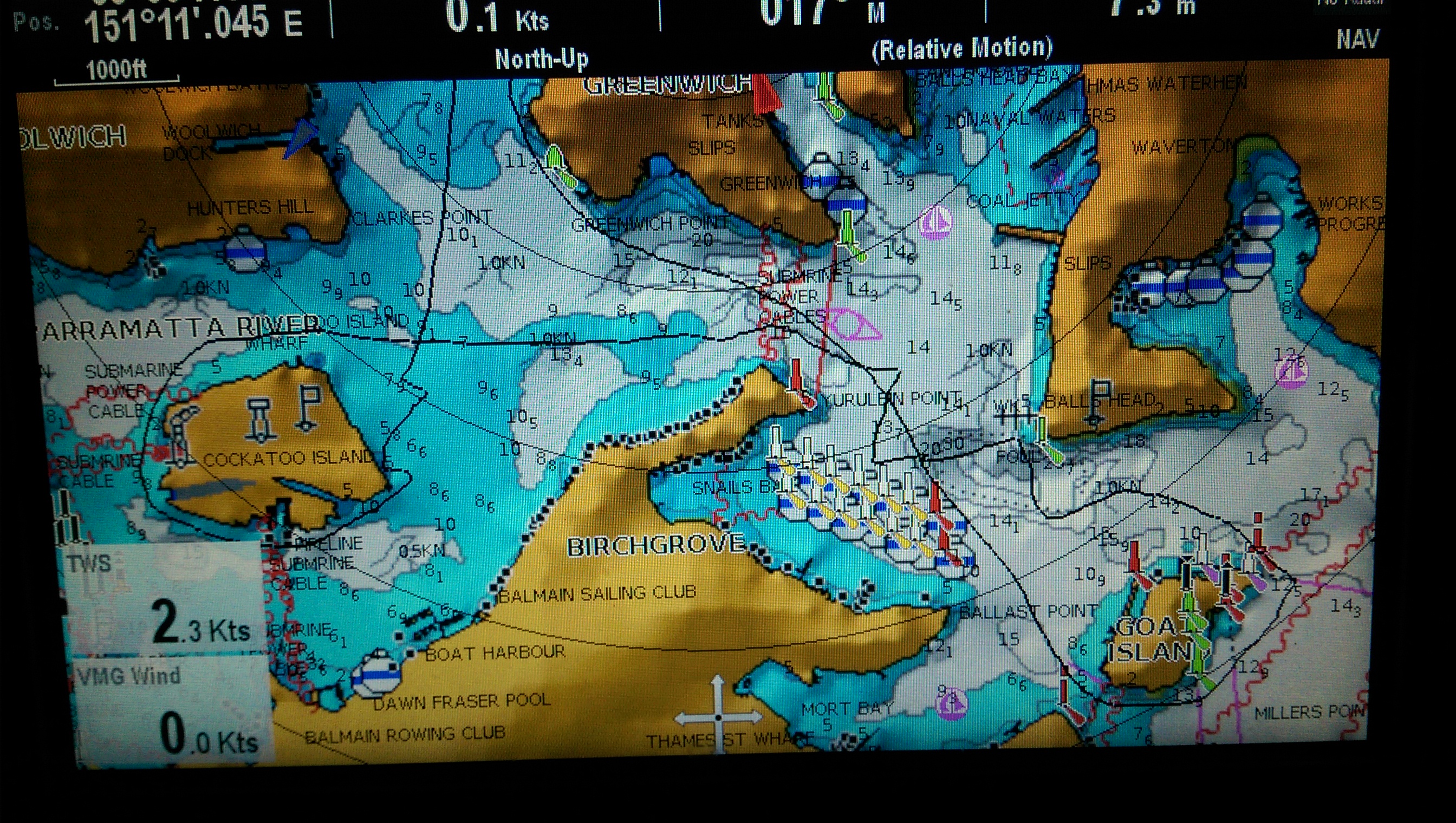
Shifty conditions on our Wednesday twilight race
A very big thank you to the loyal crew who turn up rain or shine for the twilight races at Greenwich Flying Squadron.
My thanks is directed at the crew of Passion but I am sure the other skippers at the club feel the same way about their crews.
We had 52 starters on Wednesday night despite the rain forecast and actual. The lack of wind was a deterrent to some crews who decided that a dry spot in the warm clubhouse was to be preferred over a wet drift out of Humbug. Others hung on grimly despite the lack of wind and the wet but were defeated not by lack of perseverance but by lack of wind. My congratulations go to those crews who hang on in the hope of finishing before the time limit.
The combination of comfort seekers and wind less crews meant that only 25 yachts finished and at the prize giving afterwards even the last place in some divisions scored a well deserved prize.
For our part in Blue division we made a good start and went wide at the exit to Humbug to be in the lead group working to Goat Island. In the process we caught a fair part of the Black fleet that had started five minutes earlier and the Green fleet that had started ten minutes earlier. As a consequence of going wide we needed to take the lifts to cover Aggrovation and Worlds Apart but were unable to go up due to a Green fleet yacht with no steerage. We were not particularly stellar working to windward as Aggrovation and Worlds Apart pulled away and we found ourselves in the dirty air of a new competitor in a nice quick Elan 37 and with Izzi just to windward of them. Fortunately we negotiated the dead patch around the lee of Goat Island a little better and came out with our nose in front of these two but looking at Aggrovation and Worlds Apart in the distance.
Around Goat Island Farrst Company picked up some following breeze and made gains on the fleet to win on handicap. Luckily for us the fleet went high for the freshening breeze but then had to bear away with nothing behind them.
Entering Humbug we could see Aggrovation and Worlds Apart becalmed on the Woolwich shore so we went a little higher and kept better breeze so much so that by the finish we were close enough to Worlds Apart to beat her on handicap by a few seconds into third place.
A third fastest and third on handicap seemed an unlikely result rounding Goat Island but we are not complaining.

12, 8 mm bolts holding the chainplate in place. The bolts are cut to length so that most of the bearing on the frame is on solid shank and not on thread. The deck is sealed with Sikaflex and all the holes primed with epoxy.

Dome nuts on the chainplate backing plates for neatness.

Stanchion bases sit on epoxy glass wedges cut from the laminate I showed in the last post. The bolts go through 24 mm of plywood.
Milestones of sorts with all the underside of the deck and cabin top painted and the start of installing the fittings on the deck. All the chainplates that hold up the mast are installed and most of the stanchion bases. The final coat of paint has been applied inside all the main lockers and undercoat applied in the quarter berth. Five of the six coats of paint are on the toe rails so while there is not much progress to see there has been progress nevertheless.
Last Wednesday we managed a third fastest time and another sixth place on handicap but it was a surprise result considering where we were going around Goat Island.
We made a couple of mistakes. One of my crew suggested we needed a private blog for the crew and another for the competitors because the fleet seemed to have learnt from our prior blog that carting everyone up into the wind shadow in the lee of Greenwich is not fast. This week they all kept to the Onions Point shore and as a result we were blanketed. The real mistake was leaving the back stay on too tight. We need a degree of forestay sag to get the flow forward in the genoa. Indeed as the wind strengthens the sag becomes too much and then we need backstay but on last Wednesday I was concentrating too much on the mainsail shape to the detriment of our genoa shape. Apart from that it was not too bad a race. We made a couple of good calls where we passed izzi and French Connection and one bad one when French Connection went further into Goat Island and out of the tide. They had better wind angle and better speed going to the navigation mark at Goat Island and made a good break. Our luck was in the beat back through Humbug where we were behind French Connection and a big black fleet boat. French Connection called for water and I thought the big black fleet boat had called for water and said you tack. French Connection tacked immediately but the black fleet yacht carried on. We had already moved to go behind them so by the time they tacked we were right on Onions Point and heading right into the breeze. Now normally when the genoa is backed you think about tacking but I was sitting there hoping the tide would carry us around the point. Just as I gave up hope and called for a tack the wind lifted 30 degrees so we hauled the genoa back in and crept around the point ahead of French Connection and the black fleet yacht who had tacked away.
The other action that gave us third on handicap was Gwhizz going for a detour. They had sailed well for the night being as quick and often five degrees closer to the wind than Passion but they followed the Black fleet and by the time they decided that we were going the right way we were back in front of them. Gwhizz has been quick these last two weeks so I am sure they will give us a good run this week.
Full marks to Worlds Apart who gave us a sailing lesson and Aggrovation who kept them honest.

A familiar angle on our Didi 40 Cr but with the masking off the boot top

The next time we see the keel of our Didi 40 Cr it should be at the dock

Lots of toe rail cut and drilled ready for more coats of paint.
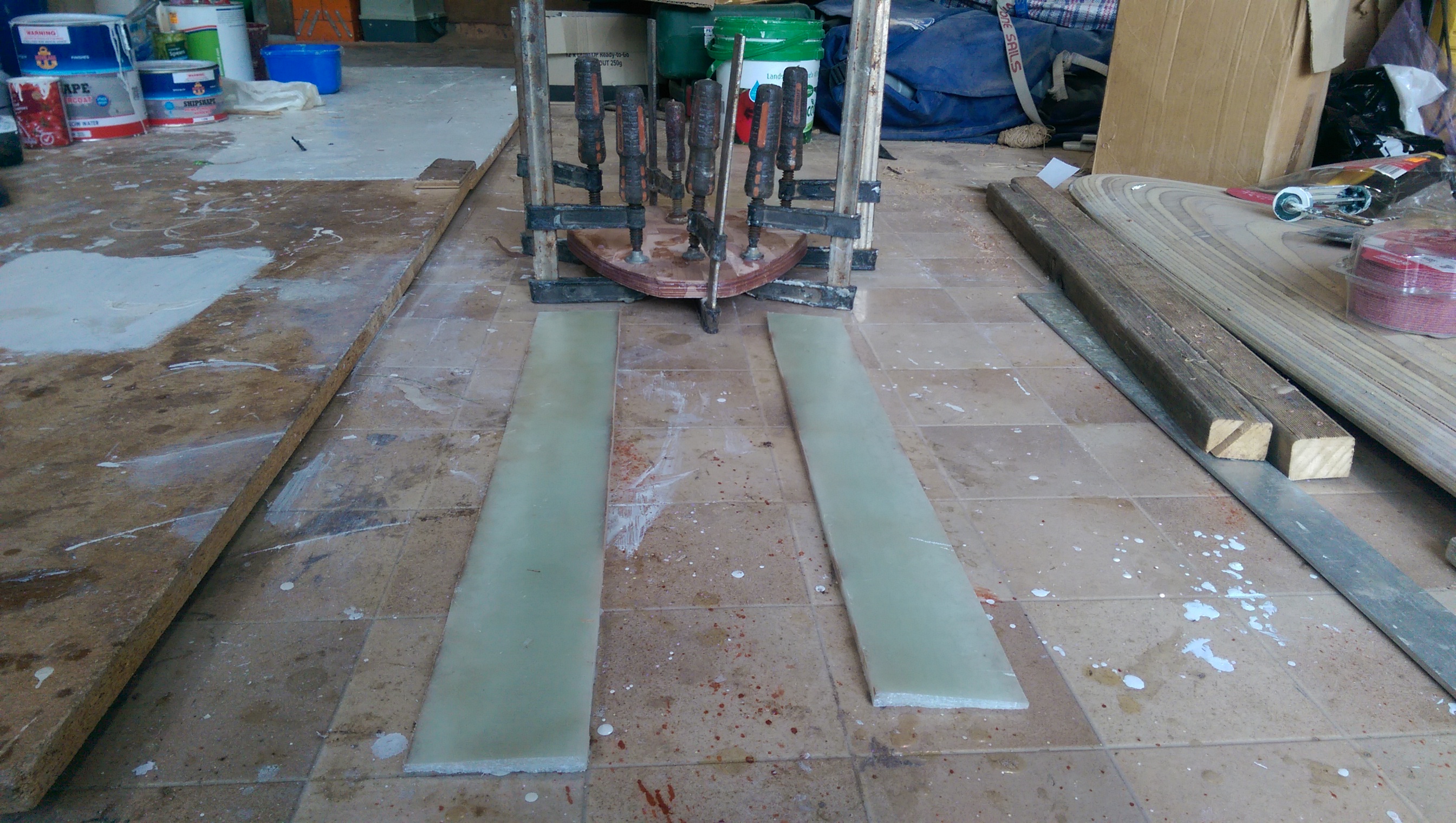
Epoxy glass wedges ready to be cut and drilled for stanchion packers and a plywood spacer for under the mast step

Elaine has surrendered her carport for the day while I epoxy coat more lids and locker bases. One of the bases is for the hot water system and I have to bolt the water tank to the base and then install them together. I think the same will be done on the fridge compressor base.
Progress seems painstakingly slow as there are no dramatic photos to show for the week’s effort. The daily trips to Somersby to fair the keel took up much of the day and painting under the deck the balance of the time.
By Friday afternoon the second side of the keel had three layers of filler sanded and faired and two coats of International Interprotect. On the underside of the keel there is now four layers of Interprotect and the first coat of antifouling so we can stand the keel on the base when we take it to the dock.
Now that the underside or the deck is painted I am pushing on with the bite and pieces needed to fit all the fittings to the deck and cabin top.
I have laminated up some epoxy glass wedged to go under the stanchion bases, sanded and pre drilled the toe rails and started making the packer for under the mast step. The epoxy glass wedges are three mm on the thin side and 9 on the thick side and will protect the deck from stanchion sticking through the hollow base.
I thought I had made good progress with the packer for under the mast but decided to add a second layer of plywood so that it does not taper to nothing at the rear edge. The extra layer has been cut and the glue will be cured by the morning ready to recommence shaping the taper.
Today I cut to length, sanded and pre drilled all the toe rails. The holes are at 200 mm spacing to make sure we get a nice bend around the gunwale. I had previously epoxy coated the timber and now they have a coat of pigmented primer. I suspect another two coats of primer will be needed as a minimum because on the plywood panels I am painting at the same time I can still see wood grain after two thick coats. I think it matter not whose brand you are using and the International recommendation of four coats of epoxy primer on the timber seems to be what is needed for areas subject to regular water contact. Yes the toilet pedestal is getting four coats of primer and then undercoat and top coat.
I do get some pleasure from looking at the top sides and when the wind blew the tarpaulin off the front of the boat during the week I thought it looked pretty smart so I took a photo for the blog.
I have finished painting the v berth area and the cabin top and sides of our Didi 40 Cr. There is four or five coats of paint depending on the area and the standard of finish I want. Under the berth it is all epoxy while in the living spaces I am using International Toplac. There is still a lot of painting to do. The lockers need a final coat of two pack epoxy gloss while most of the under deck area in the main cabin needs the last coat of Toplac. That still leaves the bulkheads and locker fronts to have their final undercoats and top coat but that will have to wait until the water tanks, settee seats, engine enclosure, fridge and kitchen benches are completed. This week should see enough of the painting finished that we can start bolting on deck and cabin top fittings, hatches and portlights and clear some of the rumpus room and sun room of fittings.

V Berth painting finished. Now I can install the varnished bunk tops.

The ceiling and cabin sides of our Didi 40 Cr are painted ready for varnishing the laminated beams.

The ceiling and hatch in the V berth ante room.

The clean underside of the deck painted and holed drilled ready for screwing on the genoa tracks
When we poured the lead into the structural steel fin of the keel the heat from the lead distorted the 5 mm steel plate forming vertical ridges between the internal vertical steel structure. This week the fabricator let us use his paint shop to bog and fair the keel in preparation for shipping to the dock. On Monday, Tuesday and Wednesday we added epoxy bog of different thickness to the hollows and today I completed the sanding and applied two coats of Interprotect. Next Tuesday we will turn the keel over and do the other side. Back on the hull I have finished the seat in the V berth ante room which will be the home for the hot water system. The cross frame that forms the front of the seat is bogged to the hull and fastened with cleats to the hanging locker and the mast support frame. It is all painted except for the base for the water heater which needs another coat so now I can complete the floor in this area. The other hanging locker on the quarter berth ante room had been grouted to the hull too. Because the bottom of the front of the locker lands on a stringer there was not a large filleting area so I glassed over the fillet to make it stronger. There is still a little return to do at the top to form a tiny shelf for items you want close at hand.
I have decided to swing the head door out the same way it does on our Jeanneau SO37 Passion. This means a small adjustment to the top of the door and a small repair to the top of the door frame. I have done a trial hang of the door so i know the top is going to work OK. What I do not know is if the bottom edge of the door will clear the engine cover and kitchen. The door is quite a bit wider than on Passion so there is scope for narrowing it up in the lower section below the kitchen bench height so it is still a work in progress.

The keel of our Didi 40 Cr filled and faired on the starboard side.

The first of two coats of Interprotect over the epoxy bog on the keel of our Didi 40 Cr

The delta bulb on our Didi 40 Cr has a tonne of lead inside the steel former. The bulb is particularly fair and needed no filler.